
How to Setup an Acetate Production Plant 2026 DPR: Cost, Licenses & Process ExplainedManufacturing ProductionUpdated on May 22, 2026 View more like this | Visit United States Minor Outlying Islands, UN | Contact IMARC Group |
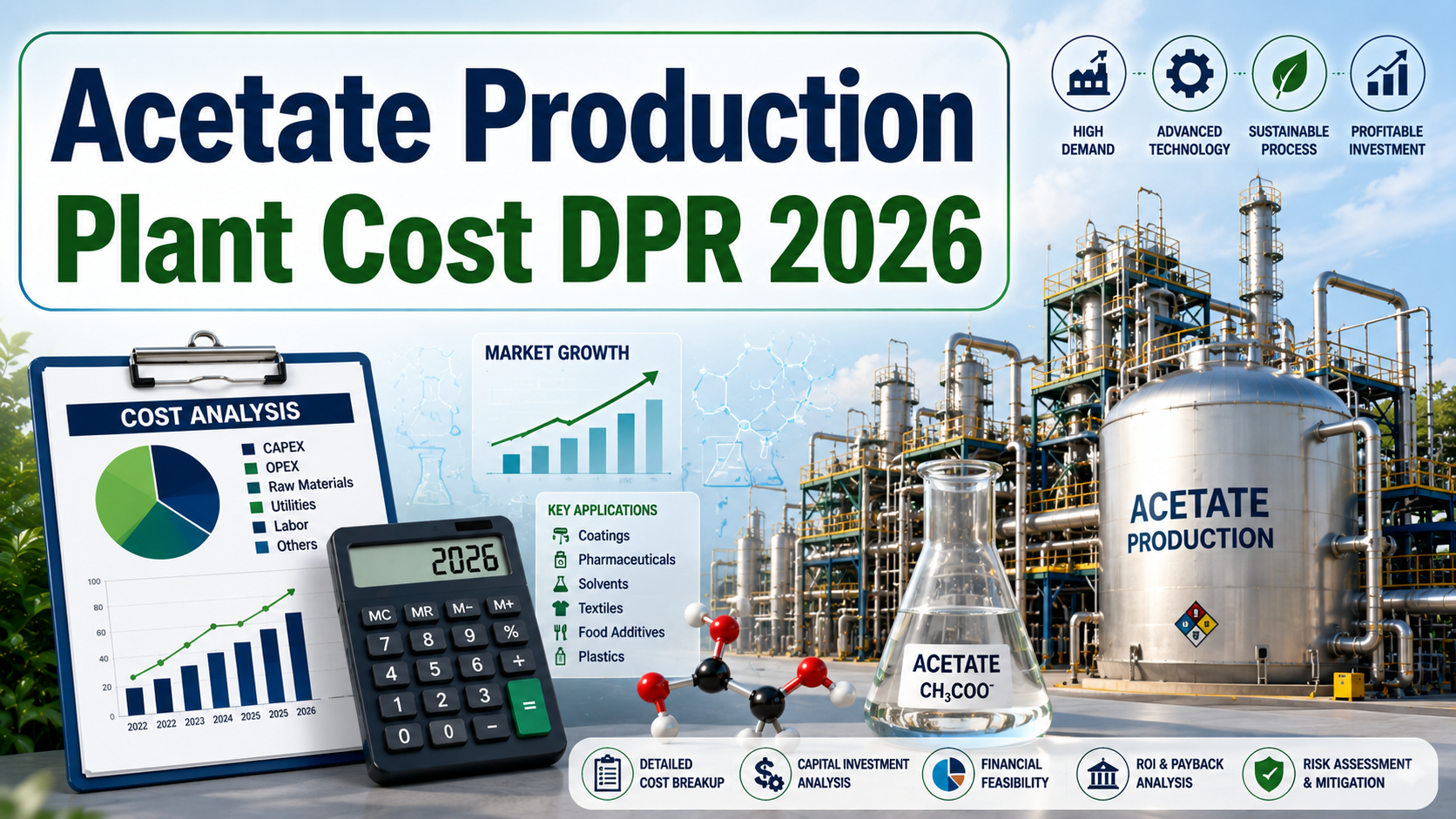
An acetate production plant is an industrial facility established to manufacture acetate compounds through chemical processes including esterification, acetylation, hydrolysis, and precipitation. Production activities may involve the synthesis of cellulose acetate using wood pulp or cotton linters in combination with acetic acid and acetic anhydride, as well as the manufacturing of metal acetate salts and ester-based solvents. Acetate products are widely utilized across industries such as textiles, pharmaceuticals, packaging, photography, and consumer goods. Since these facilities require substantial capital investment, determining the accurate acetate production plant cost is crucial for effective project planning and financial feasibility evaluation.
Understanding the Acetate Industry
Acetate is a highly versatile chemical compound, specifically a salt or ester derived from acetic acid, with applications spanning a broad range of industrial sectors. In the textile and fashion industry, cellulose acetate is valued for its soft texture, silk-like appearance, excellent draping characteristics, and wrinkle resistance, making it a preferred material for garment linings, dresses, and sportswear. Beyond textiles, cellulose acetate is widely used in the production of lightweight and durable plastics for products such as eyeglass frames, photographic films, and cigarette filters. As an important chemical intermediate, acetate also serves as a key raw material in pharmaceuticals, paints, coatings, food preservation solutions, and specialty chemicals. According to industry insights, the Asia-Pacific region accounts for more than 45% of global acetate consumption, supported by strong demand from textile manufacturing and industrial production hubs.
Applications of Acetate Across Industries
Acetate is used extensively across multiple industries, making it one of the most commercially significant chemical derivatives. In the textile and apparel sector, acetate fibers are widely utilized in fabric manufacturing, garment linings, dresses, and home furnishing products due to their silky feel, biodegradable nature, and environmentally friendly characteristics. In the filtration industry, acetate-based filter tow remains the primary material used in cigarette filters and industrial filtration applications. The photography and film sector depends on cellulose acetate as a reliable film base for photographic, cinematographic, and archival purposes. Acetate also plays an important role in plastics and packaging, where it is used in biodegradable sheets, specialty packaging materials, and consumer products such as eyeglass frames and tool handles. In pharmaceutical and medical applications, acetate functions as a buffering agent, excipient, and packaging material. As a significant share of acetate production is directed toward high-value applications, accurately evaluating the total acetate production plant cost becomes essential during project development and investment planning.
Get the Sample Report: https://www.imarcgroup.com/acetate-manufacturing-plant-project-report/requestsample
Key Factors for Acetate Plant Setup Requirements
Establishing an acetate production plant requires careful consideration of several key factors that directly impact both the initial plant setup cost and long-term profitability.
- Raw Materials and Chemical Supply: The cost and availability of primary raw materials particularly acetic acid, acetic anhydride, and cellulose pulp or cotton linters are paramount. A secure and cost-effective supply chain is vital for managing the acetate production manufacturing cost.
- Manufacturing Technology and Equipment: The choice of production technology, including esterification reactors, distillation columns, hydrolyzers, crystallizers, and drying systems, directly influences process efficiency and the final acetate production plant cost.
- Environmental Compliance and Approvals: Securing environmental clearances and adhering to regulations for chemical emissions, effluent treatment, and solvent handling is essential. This ensures sustainable operations and avoids costly penalties and shutdowns.
- Location and Infrastructure: Proximity to raw material suppliers and downstream industrial consumers, along with access to reliable power supply, water resources, and transportation networks, significantly impacts operational efficiency and overall acetate production cost analysis.
Detailed Process Flow and Quality Control
The manufacturing process for acetate involves a series of precisely controlled chemical operations. For cellulose acetate, the process begins with pre-treatment of cellulose (wood pulp or cotton linters), followed by acetylation using acetic anhydride in the presence of a catalyst. The resulting cellulose triacetate is then hydrolyzed to the desired degree of substitution, precipitated, washed, dried, and formed into flakes or pellets. For acetate esters and salts, esterification of acetic acid with alcohols under controlled temperature and pressure is the core reaction, followed by distillation, neutralization, and purification. A thorough acetate production plant report would detail each of these critical steps.
- Unit Operations Involved: Key stages include raw material pre-treatment, acetylation or esterification, hydrolysis, distillation, precipitation or crystallization, drying, blending, and packaging. Each step is carefully controlled to ensure optimal yield and product quality.
- Mass Balance and Raw Material Requirements: A precise mass balance calculation is essential for determining the exact quantity of acetic acid, acetic anhydride, cellulose or alcohol, catalysts, and solvents needed per unit of finished acetate. This directly influences the total acetate production manufacturing cost.
- Quality Assurance Criteria: Quality is assessed based on purity levels, degree of substitution (for cellulose acetate), viscosity, moisture content, and freedom from impurities. Technical tests including chemical analysis, volatility measurements, and stability testing are performed to meet end-use specifications.
Buy Report Now: https://www.imarcgroup.com/checkout?id=19086&method=2175
Cost of Setting Up an Acetate Production Plant:
The cost of establishing an acetate production plant depends on plant capacity, technology selection, location, level of automation, and regulatory compliance obligations. A detailed cost assessment covering both capital and operational expenditure is essential for accurate financial planning.
CapEx and OpEx Analysis for Acetate Production Manufacturing Cost:
- Raw Material Costs: As the largest component of variable costs, the price of acetic acid and acetic anhydride which together account for approximately 55–65% of total operating expenses is a major determinant of production economics. Global acetic acid price fluctuations significantly impact profitability.
- Capital Investment: The initial plant setup cost for esterification reactors, distillation columns, acetylation vessels, drying systems, material handling equipment, land, and construction constitutes a significant barrier to entry. This one-time investment is amortized over the plant's operational life.
- Operational Costs: These include fixed costs such as skilled labor, maintenance, and insurance, as well as variable costs including utilities (electricity, steam, and water, which account for approximately 15–20% of OpEx), catalyst replacement, solvent recovery, and environmental compliance measures.
- Grade and Purity: The degree of substitution, purity profile, and impurity levels of the acetate affect its suitability for end-use applications. Consistent quality with appropriate specifications is critical and impacts downstream processing requirements.
- Manufacturing Capacity: The scale of manufacturing significantly influences unit costs through economies of scale. The proposed production facility is designed with an annual capacity ranging between 5,000–15,000 tons, enabling economies of scale while maintaining operational flexibility. Gross profit margins typically range between 35–45%, with net profit margins of 18–25% under normal operating conditions.
- Location and Market Conditions: Geographical location influences transportation costs for raw materials and finished products, as well as access to skilled labor. Proximity to textile mills, pharmaceutical manufacturers, and packaging companies, as well as regional market demand, affects pricing and logistics costs.
Ask An Analyst: https://www.imarcgroup.com/request?type=report&id=19086&flag=C
Leading Acetate Producers
The global acetate market is served by several major chemical and specialty materials companies who lead the industry in production capacity, product diversity, and technological advancement.
- Celanese Corporation
- Eastman Chemical Company
- Daicel Corporation
- Mitsubishi Chemical Group
- Cerdia International GmbH
- Wacker Chemie AG
- LyondellBasell Industries N.V.
- Jiangsu Sopo (Group) Co., Ltd.
Timeline to Start the Plant
- Feasibility study and project report preparation
- Land acquisition and site development
- Regulatory approvals and environmental clearances
- Factory licence and fire safety compliance
- Machinery procurement and installation
- Raw material supplier agreements and supply chain setup
- Trial production and quality testing
- Commercial production launch
The overall timeline typically ranges from 18 to 36 months, depending on site development, machinery installation, environmental clearances, and trial run completion.
Licences and Regulatory Requirements
Starting an acetate production unit requires several approvals:
- Business registration (Proprietorship, LLP, or Pvt Ltd)
- Factory Licence under the Factories Act
- Environmental Clearance from State Pollution Control Board
- GST Registration
- Fire Safety NOC
- Effluent Treatment Plant (ETP) operational clearance
- Occupational Health and Safety compliance
- Hazardous chemicals handling and storage permits
Frequently Asked Questions:
- How much does it cost to set up an acetate production plant?
Capital requirements generally include land acquisition, civil construction, equipment procurement (reactors, distillation columns, dryers, packaging systems), pre-operative expenses, and initial working capital. The total investment varies with plant capacity, technology choice, and location. A detailed feasibility report provides accurate, project-specific cost estimates.
- Is acetate production profitable in 2026?
Yes. Acetate production offers strong profitability potential, driven by robust demand from textiles, packaging, pharmaceuticals, and specialty chemicals industries. Gross profit margins typically range between 35–45%, with net margins of 18–25%. Profitability depends on raw material sourcing efficiency, energy costs, operational scale, and market pricing conditions.
- What machinery is required for an acetate production plant?
Key equipment includes esterification or acetylation reactors, distillation columns, hydrolyzers, condensers, crystallizers, filtration and washing systems, drying units, blending tanks, and storage tanks. Emission control systems, effluent treatment equipment, and quality control instruments are also essential for regulatory compliance and product consistency.
- What licences and approvals are required to start an acetate production plant?
Typical requirements include business registration, factory licence, environmental clearance, GST registration, fire safety approval, and compliance with occupational health and safety regulations. Additional hazardous chemical handling permits may be required depending on the type of acetate being produced and local regulations.
- What raw materials are needed for acetate production?
The primary raw materials include acetic acid and acetic anhydride (for esterification and acetylation processes), along with cellulose pulp or cotton linters for cellulose acetate, or alcohols such as ethanol and methanol for acetate ester production. Catalysts (sulfuric acid or metal oxides), solvents, and stabilizing agents are also used during processing and purification.
- What are the environmental compliance requirements for an acetate production plant?
Manufacturers must obtain environmental approvals, install air and water pollution control systems, manage solvent recovery and recycling, and comply with emission standards, effluent treatment regulations, and hazardous chemical storage guidelines. Volatile organic compound (VOC) emissions and wastewater from washing and precipitation processes require particular attention.
- What is the best location to set up an acetate production plant?
Ideal locations offer easy access to raw materials (acetic acid suppliers, cellulose or alcohol producers), reliable power and water supply, strong logistics infrastructure, and proximity to downstream industries such as textile mills, pharmaceutical manufacturers, packaging companies, and specialty chemical distributors.
- What is the break-even period for this type of plant?
The break-even period generally ranges from 5 to 8 years, depending on plant scale, capital investment, operating efficiency, raw material costs, and market demand. Efficient production, export opportunities, and capacity utilization rates can help accelerate returns.
- What government incentives are available for manufacturers?
Governments may offer various incentives such as capital subsidies, tax benefits under schemes like Make in India, reduced utility tariffs, export incentives, and interest subsidies under industrial development and manufacturing promotion schemes. Incentives related to chemicals sector expansion and sustainable/bio-based manufacturing may also be applicable.
About Us:
IMARC Group is a global management consulting firm that helps the world's most ambitious changemakers to create a lasting impact. The company excels in understanding its client's business priorities and delivering tailored solutions that drive meaningful outcomes. We provide a comprehensive suite of market entry and expansion services. Our offerings include thorough market assessment, feasibility studies, company incorporation assistance, factory setup support, regulatory approvals and licensing navigation, branding, marketing and sales strategies, competitive landscape, and benchmarking analyses, pricing and cost research, and procurement research.
Contact Us:
IMARC Group
134 N 4th St. Brooklyn, NY 11249, USA
Email: [email protected]
Tel No: (D) +91 120 433 0800
United States: (+1-201-971-6302)
