
Philippines Banking-as-a-Service (BaaS) Market: Size, Share, Trends, Analysis, Growth & Forecast to 2026-2034General BusinessUpdated on Jun 15, 2026 View more like this | Visit TRAPPE, MD | Contact IMARC Group |
Market Overview
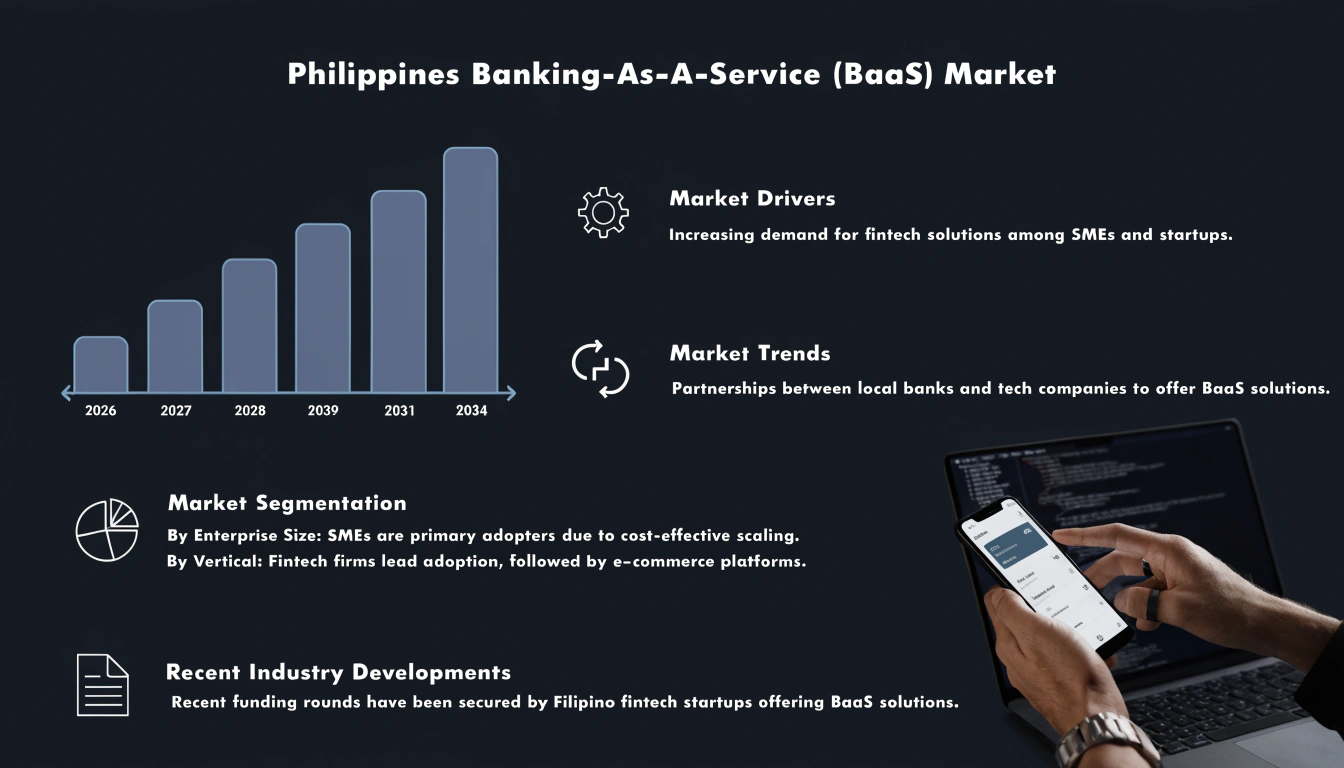
The Philippines banking-as-a-service (BaaS) market is experiencing rapid expansion, driven by a progressive regulatory framework that promotes open finance and API-based banking, as well as explosive growth in digital payment adoption across the archipelago. According to IMARC Group, the market size reached USD 746.92 Million in 2025 and is projected to surge to USD 2,077.68 Million by 2034, exhibiting a compound annual growth rate (CAGR) of 12.04% during 20262034. The Bangko Sentral ng Pilipinas (BSP) has established a comprehensive Open Finance Framework that sets common standards for data sharing, consent management, and governance, ensuring that innovation proceeds without compromising financial stability.
This market is strategically important to the Philippines' digital economy as it enables non-bank businessessuch as retailers, digital platforms, and fintechsto embed financial services like payments, lending, wallets, and deposits directly into their ecosystems through APIs and licensed banking partners. The adoption of BaaS reflects broader shifts toward digital finance transformation, where high mobile penetration and increasingly mainstream digital payments are creating demand for seamless, embedded financial experiences across the country.
*The Philippines banking-as-a-service market is poised for sustained expansion, driven by a projected CAGR of 12.04% through 2034, the BSP's Open Finance Framework establishing common standards for API data sharing, and growing adoption of embedded finance models through super-apps like GCash and Maya. With continued investment in BaaS infrastructure from licensed platforms such as Netbank, and the BSP's strategic roadmap for open finance and interoperability, the market presents significant opportunities for financial institutions, fintech innovators, and technology partners to deliver inclusive, modular banking services to underserved populations.*
Philippines Banking-as-a-Service (BaaS) Market Summary
The Philippines banking-as-a-service market encompasses a range of platform and service offerings, including API-based BaaS and cloud-based BaaS, designed to allow third-party businesses to embed financial services such as payments, lending, digital wallets, and accounts into their customer experiences without obtaining their own banking license.
The ecosystem includes licensed digital banks, traditional banks with API capabilities, BaaS platform providers, fintech companies, e-commerce platforms, super-apps, and regulatory bodies such as the BSP. Key participants serve a diverse range of end users, including banks, non-bank financial corporations, fintech startups, e-commerce platforms, and small and medium enterprises (SMEs).
Segmentation Analysis
Segment Category
Component Platform, Service (Professional Service, Managed Service)
Product Type API-based BaaS, Cloud-based BaaS
Enterprise Size Large Enterprise, Small and Medium Enterprise
End User Banks, NBFC/Fintech Corporations, Others
Region Luzon, Visayas, Mindanao
Key Market Drivers
Progressive regulatory framework establishing open finance infrastructure and interoperability standards.
Explosive growth in digital payment adoption, with super-apps like GCash and Maya reaching tens of millions of users.
Strategic implementation of API-based banking systems enabling financial inclusion across previously underserved populations.
Expansion of embedded finance models and regulatory sandboxes promoting fintech innovation.
Active government support for digital banking licenses and the BSP's strategic roadmap for open finance.
PORTER’S FIVE FORCES ANALYSIS PHILIPPINES BANKING-AS-A-SERVICE (BAAS) MARKET
The competitive dynamics of the Philippines banking-as-a-service market can be analysed using Porter's Five Forces framework.
Bargaining Power of Suppliers Moderate
The market relies on a mix of licensed BaaS platform providers, API management technology vendors, cloud infrastructure providers, and core banking system suppliers. Specialised providers such as APIwiz, which powers RCBC's Digital Marketplace 2.0, hold some influence due to their technological expertise and integration capabilities. However, the presence of multiple international and local technology vendors, along with the BSP's standardised API framework, provides financial institutions with alternative sourcing options, balancing supplier power. The strategic partnership between RCBC and Hungry Workhorse Consultancy Inc., serving as the local implementation arm for APIwiz, demonstrates how institutions can leverage specialised expertise without becoming dependent on a single supplier.
Bargaining Power of Buyers High
Buyers include licensed digital banks, traditional banks, non-bank financial institutions, fintech companies, e-commerce platforms, and super-apps. With a growing number of BaaS platform providers entering the marketincluding Netbank, which raised Series B funding led by Altara Ventures to expand its BaaS platformbuyers have increasing choice. The availability of both API-based and cloud-based BaaS products provides flexibility for buyers, and large digital ecosystems such as GCash and Maya, which serve tens of millions of users, have substantial negotiating power when selecting BaaS partners. The potential for platform switching, particularly with the BSP's emphasis on API standardisation, further enhances buyer leverage.
Threat of New Entrants Moderate
The market presents moderate barriers to entry. While obtaining a full banking license requires meeting the BSP's minimum capitalisation of PHP 1 billion (approximately USD 19.2 million) and complying with stringent prudential requirements including corporate governance, risk management, cybersecurity, and anti-money laundering standards, alternative entry pathways exist. The BSP lifted its moratorium on digital banking licenses in August 2024, allowing up to four new digital banks to operate in the country starting from January 2025, accommodating new entrants. Furthermore, technology providers such as APIwiz and cloud-based BaaS platforms enable entrants to launch services without full banking licenses, creating niche opportunities for agile players.
Threat of Substitutes Low
Traditional banking services and in-house fintech development represent potential substitutes for BaaS, but they lack the efficiency, scalability, and compliance infrastructure that licensed BaaS platforms provide. Building direct API connections to multiple banks individually would require significant development resources and ongoing compliance managementchallenges that Netbank's "Partnership Based Banking" model specifically addresses by consolidating components under a single licensed entity. The BSP's Open Finance Framework, which establishes standardised data sharing and consent management, reinforces the value proposition of BaaS by enabling secure, regulated API integration across the financial ecosystem.
Competitive Rivalry Moderate
The market is moderately competitive, featuring a dynamic mix of licensed digital banks, API-first traditional banks, and specialised BaaS platform providers. Key participants include Tonik Digital Bank (holder of BSP Digital Banking License No. 001, which achieved sustained profitability in Q1 2026 with a USD 110 million loan portfolio, up 2.3 year-on-year), Netbank (operating an embedded finance platform under a full banking licence, reporting an 88% year-on-year increase in revenue in FY2025), and traditional banks such as RCBC, which launched an API marketplace powered by APIwiz with 30 priority APIs to be rolled out within the first 90 days, covering digital remittances, BaaS/embedded finance, savings, and insurance. UnionBank also contributes to the competitive landscape with its enhanced API Developer Portal, now offering 56 API endpoints with functionalities beyond core banking. Rivalry centres on API capabilities, cloud infrastructure, service reliability, and the ability to offer modular, embeddable financial solutions that meet the needs of diverse digital platforms.
Request for Sample Report: https://www.imarcgroup.com/philippines-banking-as-a-service-market/requestsample
MARKET GROWTH DRIVERS
Progressive Open Finance Framework and Regulatory Support
The BSP has established a structured, policy-driven open finance framework that serves as a primary catalyst for BaaS market expansion. Unlike market-led approaches seen in other regions, the BSP has taken a proactive role in setting common standards for data sharing, consent management, and governance, ensuring that innovation proceeds without compromising financial stability. By aligning open finance with broader fintech regulatory policies, the BSP is creating a controlled environment where banks and fintech firms can experiment responsibly, reducing uncertainty for incumbents while providing startups with a clear integration pathway.
A landmark development occurred in August 2024 when the Monetary Board approved the lifting of the moratorium on the issuance of new digital banking licenses, effective 1 January 2025, allowing a maximum of 10 digital banks to operate in the countryaccommodating four additional digital banking licensees. This regulatory opening is expected to attract new entrants and drive further investment in BaaS infrastructure. The BSP has also introduced regulatory technology platforms like ASTERisC* and is implementing mandatory QRPh interoperability and Project Nexus for cross-border instant payments, creating standardised rails that reduce integration friction for BaaS providers.
Strategic Implementation of API-First Banking Systems
Philippine financial institutions are rapidly adopting API-first strategies to accelerate digital transformation and enable ecosystem collaboration. RCBC has emerged as a pioneer in this space, launching its "Digital 2.0 Marketplace" powered by APIwiz's centralized API management system, which empowers the bank to rapidly design, govern, and deploy composable APIs. The platform enables real-time service integration and positions RCBC as a dynamic digital platform, with 30 priority APIs scheduled for rollout within the first 90 days, covering digital remittances, embedded finance (banking-as-a-service), savings, and insurance. RCBC's collaboration with Hungry Workhorse Consultancy Inc. as the local implementation arm for APIwiz ensures seamless integration and rapid delivery of next-generation digital banking solutions.
UnionBank has similarly advanced its API capabilities, unveiling an enhanced API Developer Portal boasting an improved user interface and a more extensive API catalogue featuring 56 API endpoints with functionalities beyond traditional banking. UnionBank's underlying core systems have undergone a major rearchitecture, allowing it to expose a range of APIs through a developer-friendly Marketplace, enabling ecosystem partners to build innovative financial products and services. This API-first approach is transforming how services are built, shared, and expanded across the financial ecosystem.
Explosive Growth in Digital Payment Adoption and Embedded Finance
The Philippines has experienced explosive growth in digital payment adoption, driven by the widespread use of super-apps and digital wallets. Platforms like GCash and Maya have reached tens of millions of users, signalling sustained demand for modular banking capabilities that can be embedded directly into the customer experience. This surge in adoption has created a fertile environment for BaaS expansion, as non-bank platforms seek to integrate financial services such as payments, lending, wallets, and deposits directly into their ecosystems without managing complex compliance requirements.
More Filipinos prefer to use e-wallet platforms for their financial affairs than conventional bank accounts, with fintechs becoming increasingly popular in the Southeast Asian nation where half of the population remains unbanked. The PIDS study found that account ownership nearly doubled from 29% in 2019 to 56% in 2021, and digital payments now account for 57.4% of retail transactions. BaaS enables non-bank businesses to capitalise on this digital adoption by providing the regulated backend infrastructure necessary to offer financial services, while contributing their customer base and digital interfaces to create a symbiotic ecosystem that expands financial service reach.
Expanding Financial Inclusion for Underserved Populations
The Philippines presents a significant financial inclusion opportunity, with approximately half of the adult population remaining unbanked despite rapid digital adoption. The PIDS study highlights a persistent gap between strong consumer demand for digital finance and uneven institutional capacity, creating a substantial market opportunity for BaaS providers. BaaS helps extend formal financial services to underserved populations, micro-entrepreneurs, and digital-native users who may lack access to traditional bank branches. Embedded banking services can be layered into platforms that consumers already use for retail, social, or gig-economy activities.
Netbank's "Partnership Based Banking" model is directly addressing this opportunity, providing financial services infrastructure that allows third-party platforms to offer banking products to end users without managing separate provider relationships. The company notes that every fintech and platform in the Philippines eventually faces the same challenge: they need a bank that can move as fast as they do, and Netbank has built a modular, embeddable, and compliant financial services platform that solves real operational pain points for its partners. Tonik Digital Bank, the holder of BSP Digital Banking License No. 001, has also focused on credit inclusion, reporting a loan portfolio of USD 110 million, up 2.3 year-on-year, with an annualised revenue run-rate of USD 60M+, 99% derived from lending.
Philippines Banking-as-a-Service (BaaS) Market Segmentation
Segmentation analysis provides a detailed view of the Philippines banking-as-a-service market by category:
Component Insights: Platform, Service (Professional Service, Managed Service)
Product Type Insights: API-based BaaS, Cloud-based BaaS
Enterprise Size Insights: Large Enterprise, Small and Medium Enterprise
End User Insights: Banks, NBFC/Fintech Corporations, Others
Regional Insights: Luzon, Visayas, Mindanao
Competitive Landscape
The competitive landscape of the Philippines banking-as-a-service market is characterised by a dynamic mix of licensed digital banks, API-first traditional banks, and specialised BaaS platform providers. Key participants drive the market by expanding API capabilities, investing in AI-powered risk management and fraud detection technologies, and strengthening partnerships with fintech innovators and digital platforms. Their investments in modular banking infrastructure, cloud-based deployment models, and regulatory compliance are accelerating the adoption of embedded financial services across the archipelago.
Tonik Digital Bank holds BSP Digital Banking License No. 001 and is the Philippines' first standalone digital bank to achieve sustained profitability, generating consolidated positive cash net income in Q1 2026. The company has built a credit-led institution focused on deploying capital efficiently into consumer credit for the 90% of Filipinos unserved by formal bank lenders. Its loan portfolio reached USD 110 million, up 2.3 year-on-year, with an annualised revenue run-rate of USD 60M+, 99% from lending. Tonik's lending is diversified across employer-channel salary-deduction loans, merchant installment networks, and digital personal loans, with AI-driven risk management enabling profitable lending to thin-file borrowers.
Netbank operates an embedded finance platform under a full banking licence, providing accounts, payments, cards, and lending products to fintechs and digital platforms on a white-label basis. In April 2026, Netbank secured Series B funding led by Altara Ventures to expand its BaaS platform, following a strong year in which the company reported an 88% year-on-year increase in revenue and achieved profitability for the first time. Netbank plans to use the new capital to broaden payment capabilitiesincluding real-time disbursements, collections, and cross-border railsscale embedded lending products, and deepen account and card infrastructure.
Rizal Commercial Banking Corporation (RCBC) has emerged as a leader in API-first digital banking, launching its "Digital 2.0 Marketplace" powered by APIwiz's centralized API management system, positioning the bank as a dynamic digital platform and enabling real-time service integration. RCBC plans to roll out 30 priority APIs within the first 90 days, including services for digital remittances, embedded finance (banking-as-a-service), savings, and insurance. The bank has risen to become the fifth-largest privately-owned bank in the country with over PHP 1.3 trillion in total resources as of mid-2024, and has been recognised as the Philippines' Best Bank for Digital for five consecutive years.
UnionBank of the Philippines has unveiled an enhanced API Developer Portal featuring 56 API endpoints with functionalities beyond banking, enabling ecosystem partners to integrate services such as fund transfers, payments, and account management. The bank has undergone a major rearchitecture of its core systems, positioning itself as a leader in open API adoption to reach underserved populations. UnionDigital Bank, the bank's digital banking arm, crossed PHP 5 billion in revenue in 2023, demonstrating the growing scale of digital banking services in the Philippines.
Other key participants include traditional banks and fintech innovators such as Maya, GCash, and various emerging BaaS platform providers, along with technology enablers like APIwiz, Hungry Workhorse Consultancy Inc., and cloud infrastructure partners that provide the underlying platforms for API management and BaaS deployment.
Regional Analysis
Regional dynamics within the Philippines banking-as-a-service market are shaped by varying levels of digital adoption, economic activity, and fintech ecosystem concentration across the archipelago.
Luzon is the largest market region, driven by the concentration of major financial institutions, digital banks, and technology hubs in Metro Manila. The region benefits from the highest levels of digital payment adoption, internet penetration, and smartphone usage. Major BaaS initiatives, including RCBC's Digital 2.0 Marketplace and UnionBank's enhanced API Developer Portal, are headquartered in Luzon.
Visayas represents a growing market for BaaS services, supported by expanding digital payment adoption in urban centres such as Cebu and Iloilo. The region's increasing e-commerce activity and growing fintech presence are driving demand for embedded financial services.
Mindanao is an emerging market for BaaS adoption, with increasing smartphone usage and digital payment acceptance across Davao and other urban areas. The region's large unbanked population presents significant opportunities for BaaS providers to extend financial inclusion through digital channels.
Recent Industry Developments
April 2026: Netbank secured Series B funding led by Altara Ventures to expand its licensed banking-as-a-service platform in the Philippines, following a year in which the company reported an 88% year-on-year increase in revenue and achieved profitability.
April 2026: Tonik Digital Bank, the holder of BSP Digital Banking License No. 001, reported sustained profitability for Q1 2026, becoming the first standalone digital bank in the Philippines to achieve this milestone. The company reported a loan portfolio of USD 110 million, up 2.3 year-on-year, with an annualised revenue run-rate of USD 60M+, 99% from lending.
January 2025: The BSP began accepting applications for up to four new digital banking licenses, following the lifting of a three-year moratorium approved by the Monetary Board in August 2024.
June 2025: RCBC signed a strategic partnership agreement with Hungry Workhorse Consultancy Inc. and APIwiz to launch its "Digital 2.0 Marketplace," an API-first platform built on a centralized API management system, enabling real-time service integration.
May 2025: RCBC announced plans to roll out 30 priority APIs within the first 90 days of its API marketplace launch, including services for digital remittances, embedded finance (banking-as-a-service), savings, and insurance.
2025 (Throughout): The BSP continued to advance its Open Finance Framework, establishing standards for data sharing, consent management, and API governance, while implementing mandatory QRPh interoperability and progressing Project Nexus for cross-border instant payments.
2024 (Throughout): The BSP's regulatory technology platform ASTERisC* supported the ongoing development of open finance infrastructure, demonstrating the government's commitment to creating an enabling environment for BaaS adoption and fintech collaboration.
Browse Full Report with TOC & List of Figures for InDepth Market Insights: https://www.imarcgroup.com/philippines-banking-as-a-service-market
Note: If you need any specific information that is not covered currently within the scope of the report, we will provide the same as a part of customisation.
About Us
IMARC Group is a global management consulting firm that helps the world's most ambitious changemakers to create a lasting impact. The company provides a comprehensive suite of market entry and expansion services. IMARC offerings include thorough market assessment, feasibility studies, company incorporation assistance, factory setup support, regulatory approvals and licensing navigation, branding, marketing and sales strategies, competitive landscape and benchmarking analyses, pricing and cost research, and procurement research.
Contact Us
IMARC Group
134 N 4th St., Brooklyn, NY 11249, USA
Email: [email protected]
Tel No.: (D) +91 120 433 0800
United States: +1-201-971-6302
The Philippines banking-as-a-service (BaaS) market is experiencing rapid expansion, driven by a progressive regulatory framework that promotes open finance and API-based banking, as well as explosive growth in digital payment adoption across the archipelago. According to IMARC Group, the market size reached USD 746.92 Million in 2025 and is projected to surge to USD 2,077.68 Million by 2034, exhibiting a compound annual growth rate (CAGR) of 12.04% during 20262034. The Bangko Sentral ng Pilipinas (BSP) has established a comprehensive Open Finance Framework that sets common standards for data sharing, consent management, and governance, ensuring that innovation proceeds without compromising financial stability.
This market is strategically important to the Philippines' digital economy as it enables non-bank businessessuch as retailers, digital platforms, and fintechsto embed financial services like payments, lending, wallets, and deposits directly into their ecosystems through APIs and licensed banking partners. The adoption of BaaS reflects broader shifts toward digital finance transformation, where high mobile penetration and increasingly mainstream digital payments are creating demand for seamless, embedded financial experiences across the country.
*The Philippines banking-as-a-service market is poised for sustained expansion, driven by a projected CAGR of 12.04% through 2034, the BSP's Open Finance Framework establishing common standards for API data sharing, and growing adoption of embedded finance models through super-apps like GCash and Maya. With continued investment in BaaS infrastructure from licensed platforms such as Netbank, and the BSP's strategic roadmap for open finance and interoperability, the market presents significant opportunities for financial institutions, fintech innovators, and technology partners to deliver inclusive, modular banking services to underserved populations.*
Philippines Banking-as-a-Service (BaaS) Market Summary
The Philippines banking-as-a-service market encompasses a range of platform and service offerings, including API-based BaaS and cloud-based BaaS, designed to allow third-party businesses to embed financial services such as payments, lending, digital wallets, and accounts into their customer experiences without obtaining their own banking license.
The ecosystem includes licensed digital banks, traditional banks with API capabilities, BaaS platform providers, fintech companies, e-commerce platforms, super-apps, and regulatory bodies such as the BSP. Key participants serve a diverse range of end users, including banks, non-bank financial corporations, fintech startups, e-commerce platforms, and small and medium enterprises (SMEs).
Segmentation Analysis
Segment Category
Component Platform, Service (Professional Service, Managed Service)
Product Type API-based BaaS, Cloud-based BaaS
Enterprise Size Large Enterprise, Small and Medium Enterprise
End User Banks, NBFC/Fintech Corporations, Others
Region Luzon, Visayas, Mindanao
Key Market Drivers
Progressive regulatory framework establishing open finance infrastructure and interoperability standards.
Explosive growth in digital payment adoption, with super-apps like GCash and Maya reaching tens of millions of users.
Strategic implementation of API-based banking systems enabling financial inclusion across previously underserved populations.
Expansion of embedded finance models and regulatory sandboxes promoting fintech innovation.
Active government support for digital banking licenses and the BSP's strategic roadmap for open finance.
PORTER’S FIVE FORCES ANALYSIS PHILIPPINES BANKING-AS-A-SERVICE (BAAS) MARKET
The competitive dynamics of the Philippines banking-as-a-service market can be analysed using Porter's Five Forces framework.
Bargaining Power of Suppliers Moderate
The market relies on a mix of licensed BaaS platform providers, API management technology vendors, cloud infrastructure providers, and core banking system suppliers. Specialised providers such as APIwiz, which powers RCBC's Digital Marketplace 2.0, hold some influence due to their technological expertise and integration capabilities. However, the presence of multiple international and local technology vendors, along with the BSP's standardised API framework, provides financial institutions with alternative sourcing options, balancing supplier power. The strategic partnership between RCBC and Hungry Workhorse Consultancy Inc., serving as the local implementation arm for APIwiz, demonstrates how institutions can leverage specialised expertise without becoming dependent on a single supplier.
Bargaining Power of Buyers High
Buyers include licensed digital banks, traditional banks, non-bank financial institutions, fintech companies, e-commerce platforms, and super-apps. With a growing number of BaaS platform providers entering the marketincluding Netbank, which raised Series B funding led by Altara Ventures to expand its BaaS platformbuyers have increasing choice. The availability of both API-based and cloud-based BaaS products provides flexibility for buyers, and large digital ecosystems such as GCash and Maya, which serve tens of millions of users, have substantial negotiating power when selecting BaaS partners. The potential for platform switching, particularly with the BSP's emphasis on API standardisation, further enhances buyer leverage.
Threat of New Entrants Moderate
The market presents moderate barriers to entry. While obtaining a full banking license requires meeting the BSP's minimum capitalisation of PHP 1 billion (approximately USD 19.2 million) and complying with stringent prudential requirements including corporate governance, risk management, cybersecurity, and anti-money laundering standards, alternative entry pathways exist. The BSP lifted its moratorium on digital banking licenses in August 2024, allowing up to four new digital banks to operate in the country starting from January 2025, accommodating new entrants. Furthermore, technology providers such as APIwiz and cloud-based BaaS platforms enable entrants to launch services without full banking licenses, creating niche opportunities for agile players.
Threat of Substitutes Low
Traditional banking services and in-house fintech development represent potential substitutes for BaaS, but they lack the efficiency, scalability, and compliance infrastructure that licensed BaaS platforms provide. Building direct API connections to multiple banks individually would require significant development resources and ongoing compliance managementchallenges that Netbank's "Partnership Based Banking" model specifically addresses by consolidating components under a single licensed entity. The BSP's Open Finance Framework, which establishes standardised data sharing and consent management, reinforces the value proposition of BaaS by enabling secure, regulated API integration across the financial ecosystem.
Competitive Rivalry Moderate
The market is moderately competitive, featuring a dynamic mix of licensed digital banks, API-first traditional banks, and specialised BaaS platform providers. Key participants include Tonik Digital Bank (holder of BSP Digital Banking License No. 001, which achieved sustained profitability in Q1 2026 with a USD 110 million loan portfolio, up 2.3 year-on-year), Netbank (operating an embedded finance platform under a full banking licence, reporting an 88% year-on-year increase in revenue in FY2025), and traditional banks such as RCBC, which launched an API marketplace powered by APIwiz with 30 priority APIs to be rolled out within the first 90 days, covering digital remittances, BaaS/embedded finance, savings, and insurance. UnionBank also contributes to the competitive landscape with its enhanced API Developer Portal, now offering 56 API endpoints with functionalities beyond core banking. Rivalry centres on API capabilities, cloud infrastructure, service reliability, and the ability to offer modular, embeddable financial solutions that meet the needs of diverse digital platforms.
Request for Sample Report: https://www.imarcgroup.com/philippines-banking-as-a-service-market/requestsample
MARKET GROWTH DRIVERS
Progressive Open Finance Framework and Regulatory Support
The BSP has established a structured, policy-driven open finance framework that serves as a primary catalyst for BaaS market expansion. Unlike market-led approaches seen in other regions, the BSP has taken a proactive role in setting common standards for data sharing, consent management, and governance, ensuring that innovation proceeds without compromising financial stability. By aligning open finance with broader fintech regulatory policies, the BSP is creating a controlled environment where banks and fintech firms can experiment responsibly, reducing uncertainty for incumbents while providing startups with a clear integration pathway.
A landmark development occurred in August 2024 when the Monetary Board approved the lifting of the moratorium on the issuance of new digital banking licenses, effective 1 January 2025, allowing a maximum of 10 digital banks to operate in the countryaccommodating four additional digital banking licensees. This regulatory opening is expected to attract new entrants and drive further investment in BaaS infrastructure. The BSP has also introduced regulatory technology platforms like ASTERisC* and is implementing mandatory QRPh interoperability and Project Nexus for cross-border instant payments, creating standardised rails that reduce integration friction for BaaS providers.
Strategic Implementation of API-First Banking Systems
Philippine financial institutions are rapidly adopting API-first strategies to accelerate digital transformation and enable ecosystem collaboration. RCBC has emerged as a pioneer in this space, launching its "Digital 2.0 Marketplace" powered by APIwiz's centralized API management system, which empowers the bank to rapidly design, govern, and deploy composable APIs. The platform enables real-time service integration and positions RCBC as a dynamic digital platform, with 30 priority APIs scheduled for rollout within the first 90 days, covering digital remittances, embedded finance (banking-as-a-service), savings, and insurance. RCBC's collaboration with Hungry Workhorse Consultancy Inc. as the local implementation arm for APIwiz ensures seamless integration and rapid delivery of next-generation digital banking solutions.
UnionBank has similarly advanced its API capabilities, unveiling an enhanced API Developer Portal boasting an improved user interface and a more extensive API catalogue featuring 56 API endpoints with functionalities beyond traditional banking. UnionBank's underlying core systems have undergone a major rearchitecture, allowing it to expose a range of APIs through a developer-friendly Marketplace, enabling ecosystem partners to build innovative financial products and services. This API-first approach is transforming how services are built, shared, and expanded across the financial ecosystem.
Explosive Growth in Digital Payment Adoption and Embedded Finance
The Philippines has experienced explosive growth in digital payment adoption, driven by the widespread use of super-apps and digital wallets. Platforms like GCash and Maya have reached tens of millions of users, signalling sustained demand for modular banking capabilities that can be embedded directly into the customer experience. This surge in adoption has created a fertile environment for BaaS expansion, as non-bank platforms seek to integrate financial services such as payments, lending, wallets, and deposits directly into their ecosystems without managing complex compliance requirements.
More Filipinos prefer to use e-wallet platforms for their financial affairs than conventional bank accounts, with fintechs becoming increasingly popular in the Southeast Asian nation where half of the population remains unbanked. The PIDS study found that account ownership nearly doubled from 29% in 2019 to 56% in 2021, and digital payments now account for 57.4% of retail transactions. BaaS enables non-bank businesses to capitalise on this digital adoption by providing the regulated backend infrastructure necessary to offer financial services, while contributing their customer base and digital interfaces to create a symbiotic ecosystem that expands financial service reach.
Expanding Financial Inclusion for Underserved Populations
The Philippines presents a significant financial inclusion opportunity, with approximately half of the adult population remaining unbanked despite rapid digital adoption. The PIDS study highlights a persistent gap between strong consumer demand for digital finance and uneven institutional capacity, creating a substantial market opportunity for BaaS providers. BaaS helps extend formal financial services to underserved populations, micro-entrepreneurs, and digital-native users who may lack access to traditional bank branches. Embedded banking services can be layered into platforms that consumers already use for retail, social, or gig-economy activities.
Netbank's "Partnership Based Banking" model is directly addressing this opportunity, providing financial services infrastructure that allows third-party platforms to offer banking products to end users without managing separate provider relationships. The company notes that every fintech and platform in the Philippines eventually faces the same challenge: they need a bank that can move as fast as they do, and Netbank has built a modular, embeddable, and compliant financial services platform that solves real operational pain points for its partners. Tonik Digital Bank, the holder of BSP Digital Banking License No. 001, has also focused on credit inclusion, reporting a loan portfolio of USD 110 million, up 2.3 year-on-year, with an annualised revenue run-rate of USD 60M+, 99% derived from lending.
Philippines Banking-as-a-Service (BaaS) Market Segmentation
Segmentation analysis provides a detailed view of the Philippines banking-as-a-service market by category:
Component Insights: Platform, Service (Professional Service, Managed Service)
Product Type Insights: API-based BaaS, Cloud-based BaaS
Enterprise Size Insights: Large Enterprise, Small and Medium Enterprise
End User Insights: Banks, NBFC/Fintech Corporations, Others
Regional Insights: Luzon, Visayas, Mindanao
Competitive Landscape
The competitive landscape of the Philippines banking-as-a-service market is characterised by a dynamic mix of licensed digital banks, API-first traditional banks, and specialised BaaS platform providers. Key participants drive the market by expanding API capabilities, investing in AI-powered risk management and fraud detection technologies, and strengthening partnerships with fintech innovators and digital platforms. Their investments in modular banking infrastructure, cloud-based deployment models, and regulatory compliance are accelerating the adoption of embedded financial services across the archipelago.
Tonik Digital Bank holds BSP Digital Banking License No. 001 and is the Philippines' first standalone digital bank to achieve sustained profitability, generating consolidated positive cash net income in Q1 2026. The company has built a credit-led institution focused on deploying capital efficiently into consumer credit for the 90% of Filipinos unserved by formal bank lenders. Its loan portfolio reached USD 110 million, up 2.3 year-on-year, with an annualised revenue run-rate of USD 60M+, 99% from lending. Tonik's lending is diversified across employer-channel salary-deduction loans, merchant installment networks, and digital personal loans, with AI-driven risk management enabling profitable lending to thin-file borrowers.
Netbank operates an embedded finance platform under a full banking licence, providing accounts, payments, cards, and lending products to fintechs and digital platforms on a white-label basis. In April 2026, Netbank secured Series B funding led by Altara Ventures to expand its BaaS platform, following a strong year in which the company reported an 88% year-on-year increase in revenue and achieved profitability for the first time. Netbank plans to use the new capital to broaden payment capabilitiesincluding real-time disbursements, collections, and cross-border railsscale embedded lending products, and deepen account and card infrastructure.
Rizal Commercial Banking Corporation (RCBC) has emerged as a leader in API-first digital banking, launching its "Digital 2.0 Marketplace" powered by APIwiz's centralized API management system, positioning the bank as a dynamic digital platform and enabling real-time service integration. RCBC plans to roll out 30 priority APIs within the first 90 days, including services for digital remittances, embedded finance (banking-as-a-service), savings, and insurance. The bank has risen to become the fifth-largest privately-owned bank in the country with over PHP 1.3 trillion in total resources as of mid-2024, and has been recognised as the Philippines' Best Bank for Digital for five consecutive years.
UnionBank of the Philippines has unveiled an enhanced API Developer Portal featuring 56 API endpoints with functionalities beyond banking, enabling ecosystem partners to integrate services such as fund transfers, payments, and account management. The bank has undergone a major rearchitecture of its core systems, positioning itself as a leader in open API adoption to reach underserved populations. UnionDigital Bank, the bank's digital banking arm, crossed PHP 5 billion in revenue in 2023, demonstrating the growing scale of digital banking services in the Philippines.
Other key participants include traditional banks and fintech innovators such as Maya, GCash, and various emerging BaaS platform providers, along with technology enablers like APIwiz, Hungry Workhorse Consultancy Inc., and cloud infrastructure partners that provide the underlying platforms for API management and BaaS deployment.
Regional Analysis
Regional dynamics within the Philippines banking-as-a-service market are shaped by varying levels of digital adoption, economic activity, and fintech ecosystem concentration across the archipelago.
Luzon is the largest market region, driven by the concentration of major financial institutions, digital banks, and technology hubs in Metro Manila. The region benefits from the highest levels of digital payment adoption, internet penetration, and smartphone usage. Major BaaS initiatives, including RCBC's Digital 2.0 Marketplace and UnionBank's enhanced API Developer Portal, are headquartered in Luzon.
Visayas represents a growing market for BaaS services, supported by expanding digital payment adoption in urban centres such as Cebu and Iloilo. The region's increasing e-commerce activity and growing fintech presence are driving demand for embedded financial services.
Mindanao is an emerging market for BaaS adoption, with increasing smartphone usage and digital payment acceptance across Davao and other urban areas. The region's large unbanked population presents significant opportunities for BaaS providers to extend financial inclusion through digital channels.
Recent Industry Developments
April 2026: Netbank secured Series B funding led by Altara Ventures to expand its licensed banking-as-a-service platform in the Philippines, following a year in which the company reported an 88% year-on-year increase in revenue and achieved profitability.
April 2026: Tonik Digital Bank, the holder of BSP Digital Banking License No. 001, reported sustained profitability for Q1 2026, becoming the first standalone digital bank in the Philippines to achieve this milestone. The company reported a loan portfolio of USD 110 million, up 2.3 year-on-year, with an annualised revenue run-rate of USD 60M+, 99% from lending.
January 2025: The BSP began accepting applications for up to four new digital banking licenses, following the lifting of a three-year moratorium approved by the Monetary Board in August 2024.
June 2025: RCBC signed a strategic partnership agreement with Hungry Workhorse Consultancy Inc. and APIwiz to launch its "Digital 2.0 Marketplace," an API-first platform built on a centralized API management system, enabling real-time service integration.
May 2025: RCBC announced plans to roll out 30 priority APIs within the first 90 days of its API marketplace launch, including services for digital remittances, embedded finance (banking-as-a-service), savings, and insurance.
2025 (Throughout): The BSP continued to advance its Open Finance Framework, establishing standards for data sharing, consent management, and API governance, while implementing mandatory QRPh interoperability and progressing Project Nexus for cross-border instant payments.
2024 (Throughout): The BSP's regulatory technology platform ASTERisC* supported the ongoing development of open finance infrastructure, demonstrating the government's commitment to creating an enabling environment for BaaS adoption and fintech collaboration.
Browse Full Report with TOC & List of Figures for InDepth Market Insights: https://www.imarcgroup.com/philippines-banking-as-a-service-market
Note: If you need any specific information that is not covered currently within the scope of the report, we will provide the same as a part of customisation.
About Us
IMARC Group is a global management consulting firm that helps the world's most ambitious changemakers to create a lasting impact. The company provides a comprehensive suite of market entry and expansion services. IMARC offerings include thorough market assessment, feasibility studies, company incorporation assistance, factory setup support, regulatory approvals and licensing navigation, branding, marketing and sales strategies, competitive landscape and benchmarking analyses, pricing and cost research, and procurement research.
Contact Us
IMARC Group
134 N 4th St., Brooklyn, NY 11249, USA
Email: [email protected]
Tel No.: (D) +91 120 433 0800
United States: +1-201-971-6302
