
Liquid CoatingPowder CoatingsUpdated on Aug 28, 2017 View more like this | Visit RICHMOND, CA | Contact Professional Finishing |
Different Liquid Paint Application Methods
The liquid paints have progressed with the passage of time and technological Advancements, becoming better and safer to use. As the concerns about the air pollution became stronger, there were efforts to make liquid paints compliant to regulations and to minimize the volatile compounds in the Liquid Coating for safer use. At the same time, there has been an emphasis on improved application methods to increase the transfer efficiency. In the application methods with low transfer efficiency, a large percentage of paint is wasted, and the volatile components escape into the air, causing air pollution.
So, the new technologies are designed to increase transfer efficiency, resulting in the cost cuts and environmentally safe application of liquid paints. Some of the application methods are similar for Powder and Liquid Coating both.
In this article, a list of application methods is discussed encompassing common techniques including spraying, flow coating, and dipping.
Spray Coating:
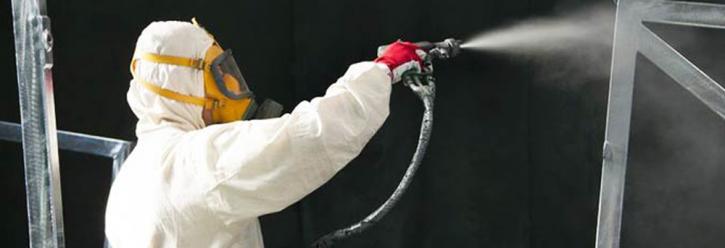
Spray coating is one of the most frequently used methods in paints. The spraying can be broken down into various methods including Air-atomized spraying, Airless spraying, and high-volume low-pressure (HVLP).
The air atomized coating used the spray guns in which air is mixed with the stream of paint internally or externally, breaking it down into small droplets that are coated on the object. Because, the stream of air and paint is fully controllable with the spray guns, allowing the user to set viscosity, speed, and drying time, it can be used to paint almost any object. The air-atomized spray guns render a smooth and high-quality Liquid Coating finish. Coming to the transfer efficiency, even with their frequent use, air atomized spray guns are considered less efficient. These create overspray, and the organic solvents in the paint evaporate in the environment. So, these spray guns are known for their high-quality, but high cost and low efficiency.
The airless atomized spraying relies on the momentum of paint stream to flow out of the small orifice in the spray gun. As the paint flows out of the orifice, the pressure causes the stream to break apart into small droplets. The airless atomization also allows controlling the stream through pressure, the thickness of the paint and size of the orifice. The airless spraying has high transfer efficiency because the paint only moves with its own momentum. As there is the less wasted product, it is less expensive and more environmentally safe than other air spraying.
High-volume low-pressure uses the heated air instead of the airless or air atomization to form the stream of paint. The heated air results in more stable paint coating and also controls the evaporation of solvents or organic compounds.
Electrostatic Spraying:
Electrostatic spraying uses the electrically charged paint particles to accumulate on the surface of the object. The electrode on the spray gun charges the particles as they pass through them and the object on the ground potential attracts them, forming a sheet of paint particles. The electrostatic spraying caused minimum waste product and had high transfer efficiency. Because of the attraction between opposites, most of the paint stream sticks to the surface of the object.
Non-Spray Methods:
Non-spray methods include dipping and flow coating. In dipping, the product is dipped into the liquid paint, prepared and accumulated in a large tank. The tank should be large enough to accommodate the object. The object is dipped, and the extra paint is cleared off from the surface. In dip coating, the coating sheet is uneven from corners and center of the object as the excess paint accumulates at the bottom or edges, and there is the light layer in the middle.
The other method is flow coating in which the paint is pumped from nozzle to the object, building in the form of a protective layer.

Professional Finishing
770 Market Avenue Richmond, California 94801
