
U.S. Microgrid as a Service Market Share and Growth Report, 2026-2035Market ResearchUpdated on Mar 9, 2026 View more like this | Visit NYACK, NY | Contact Global Trends |
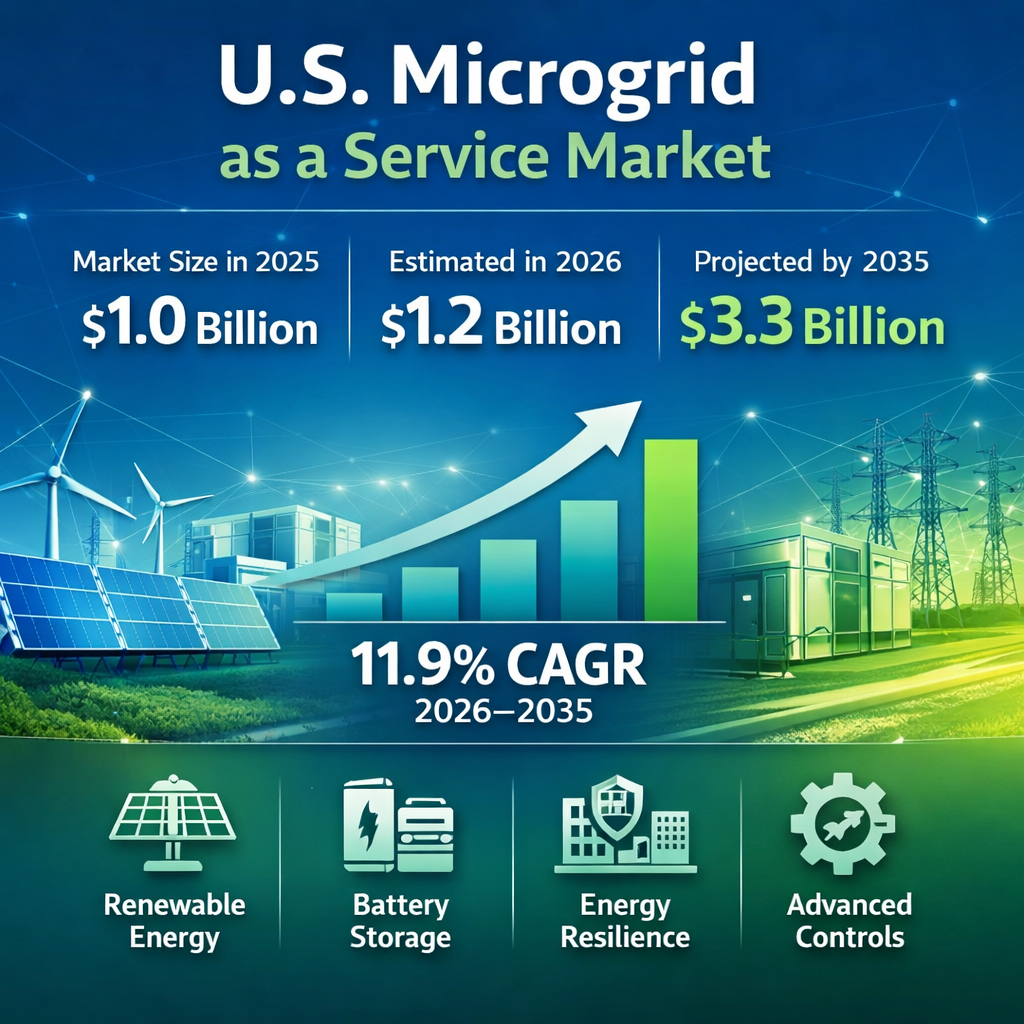
The U.S. microgrid as a service (MaaS) market, which was valued at approximately USD 1.0 billion in 2025 and is estimated to reach around USD 1.2 billion in 2026, is projected to grow significantly to nearly USD 3.3 billion by 2035, expanding at a CAGR of about 11.9% during the forecast period from 2026 to 2035.
Growing Demand for Resilient and Decentralized Energy Infrastructure
The market is witnessing strong expansion as organizations across the United States increasingly prioritize decentralized power solutions to enhance energy resilience and operational reliability. Aging grid infrastructure, extreme weather events, and the growing need for uninterrupted power across critical facilities are accelerating the adoption of microgrid services.
Utilities, commercial campuses, industrial facilities, hospitals, and data centers are increasingly deploying localized generation, energy storage, and automated control systems to maintain energy continuity and reduce dependency on centralized grid systems. In addition, the integration of renewable energy sources into microgrids is further driving adoption across the country.
Supporting this trend, the U.S. Energy Information Administration reported that utility-scale battery storage capacity in the United States increased by 66% in 2024, highlighting the rapid adoption of flexible distributed energy infrastructure.
Industry Trends Shaping the Microgrid-as-a-Service Market
One of the most significant trends shaping the market is the shift toward service-based energy models that allow organizations to deploy microgrid systems without large upfront capital investments. These models combine renewable energy generation, advanced storage systems, and intelligent energy management platforms into integrated service offerings.
Technologies such as artificial intelligence (AI), Internet of Things (IoT), predictive analytics, and advanced monitoring systems are enabling more efficient and responsive energy management solutions. These innovations are transforming microgrids from experimental energy projects into mainstream strategic assets for energy reliability and sustainability.
According to the International Renewable Energy Agency, the global power sector added 452 GW of solar photovoltaic capacity in 2024, representing more than 77% of new renewable installations, further supporting the growth of localized power systems.
Key Growth Drivers
The increasing need for energy reliability and grid resilience is one of the primary factors fueling growth in the U.S. MaaS market. Severe weather events, fluctuating electricity demand, and aging infrastructure are encouraging utilities and enterprises to adopt microgrid solutions that ensure consistent power supply.
Government policies supporting grid modernization and distributed energy resources (DERs) are also encouraging investment in microgrid deployments. Service-based models help organizations reduce operational risks while improving energy security and sustainability.
Additionally, the International Energy Agency reported that global investment in electricity grids reached USD 400 billion in 2024, emphasizing the global focus on upgrading power infrastructure to support distributed energy technologies.
Download free report sample at: https://www.vynzresearch.com/energy-power/us-microgrid-as-a-service-market/request-sample
Market Challenges
Despite strong growth potential, the market faces several challenges that may slow adoption. Complex regulatory frameworks and technical integration issues with existing grid systems often create barriers for microgrid deployment.
High upfront costs associated with planning, engineering, and system development can also discourage organizations from adopting microgrid solutions. In addition, the lack of standardized performance evaluation and a shortage of skilled professionals for designing and maintaining distributed energy systems remain ongoing industry challenges.
Emerging Opportunities
The market is expected to benefit significantly from the growing integration of renewable energy, advanced energy storage technologies, and intelligent grid management systems.
Organizations across multiple sectors are increasingly committing to carbon reduction and sustainability goals, prompting them to adopt service-based microgrids that deliver cleaner energy without major capital investment.
Federal and state incentives supporting electric vehicle infrastructure, distributed energy resources, and grid modernization initiatives are also opening new opportunities for service providers. Furthermore, the integration of AI-powered optimization tools and predictive maintenance systems is enabling providers to create additional value and long-term service partnerships with customers.
Market Segmentation Highlights
Grid-connected microgrids currently represent the largest segment with approximately 70% market share in 2025, as they allow organizations to maintain connection with the main utility grid while improving energy reliability and cost efficiency.
Islanded or off-grid microgrids are projected to experience the fastest growth, driven by demand for independent energy systems in remote areas, disaster-prone regions, and mission-critical facilities.
Among service types, monitoring and control services dominate the market due to their critical role in managing energy flow, system performance, and regulatory compliance. Meanwhile, SaaS-based microgrid management platforms are gaining popularity due to their scalability, automation capabilities, and remote monitoring features.
From an application perspective, utilities account for the largest share of the market, as they continue to invest in microgrid infrastructure to support distributed energy resources and grid balancing. However, the commercial and industrial segment is growing rapidly, driven by rising concerns about power outages, operational continuity, and energy cost management.
Regional Outlook
The Western United States represents the largest regional market due to wildfire risks, strong renewable energy potential, and proactive grid modernization initiatives. Programs such as the California Public Utilities Commission’s USD 200 million Microgrid Incentive Program launched in 2024 are accelerating adoption across the region.
Meanwhile, the Southern United States is experiencing steady growth as hurricanes, storms, and flooding frequently disrupt grid operations. Microgrid-as-a-service solutions are increasingly being deployed to ensure uninterrupted power for critical infrastructure such as hospitals, emergency services, and data centers.
Competitive Landscape
The U.S. microgrid-as-a-service market remains highly competitive and fragmented, with numerous global technology providers, energy companies, and specialized microgrid developers actively participating in project deployments.
Companies are focusing on strategic partnerships, technology innovation, and customized microgrid solutions to address the unique requirements of utilities, industrial facilities, and critical infrastructure providers.
Key players operating in the market include General Electric (GE), Eaton Corporation, ABB Ltd., Schneider Electric SE, Siemens AG, Ameresco, ENGIE, Honeywell International Inc., NRG Energy, and AlphaStruxure, among others.
These companies continue to invest in advanced energy management platforms, distributed energy technologies, and microgrid integration solutions to strengthen their presence in the evolving U.S. decentralized energy ecosystem.
About VynZ Research
VynZ Research is a global market research and consulting firm providing actionable insights, analytics, and strategic advisory services to support informed business decision-making. The company specializes in delivering in-depth research across a wide range of industries, including Chemicals, Automotive, Transportation, Energy, Consumer Durables, Healthcare, ICT, and other emerging technologies.
VynZ Research helps enterprises identify growth opportunities, navigate market challenges, and develop effective business strategies. Our reports are built on robust market data and feature comprehensive analysis and quantification of key market drivers, industry dynamics, opportunities, challenges, threats, market share insights, and emerging trends and technologies across diverse industries.
Contact Us
VynZ Research
India: +91-996-028-8381
Toll-Free (U.S. & Canada): +1-888-253-3960
Email: [email protected]
Website: https://www.vynzresearch.com
While it requires higher upfront capital for hardware, Hybrid Cloud is often cheaper in the long run for predictable workloads by eliminating continuous public cloud rental fees.
