
U.S. Cloud Security Software Market to Reach USD 72.5 Billion by 2032Market Research ConsultantsUpdated on Nov 28, 2025 View more like this | Visit NYACK, NY | Contact Global Trends |
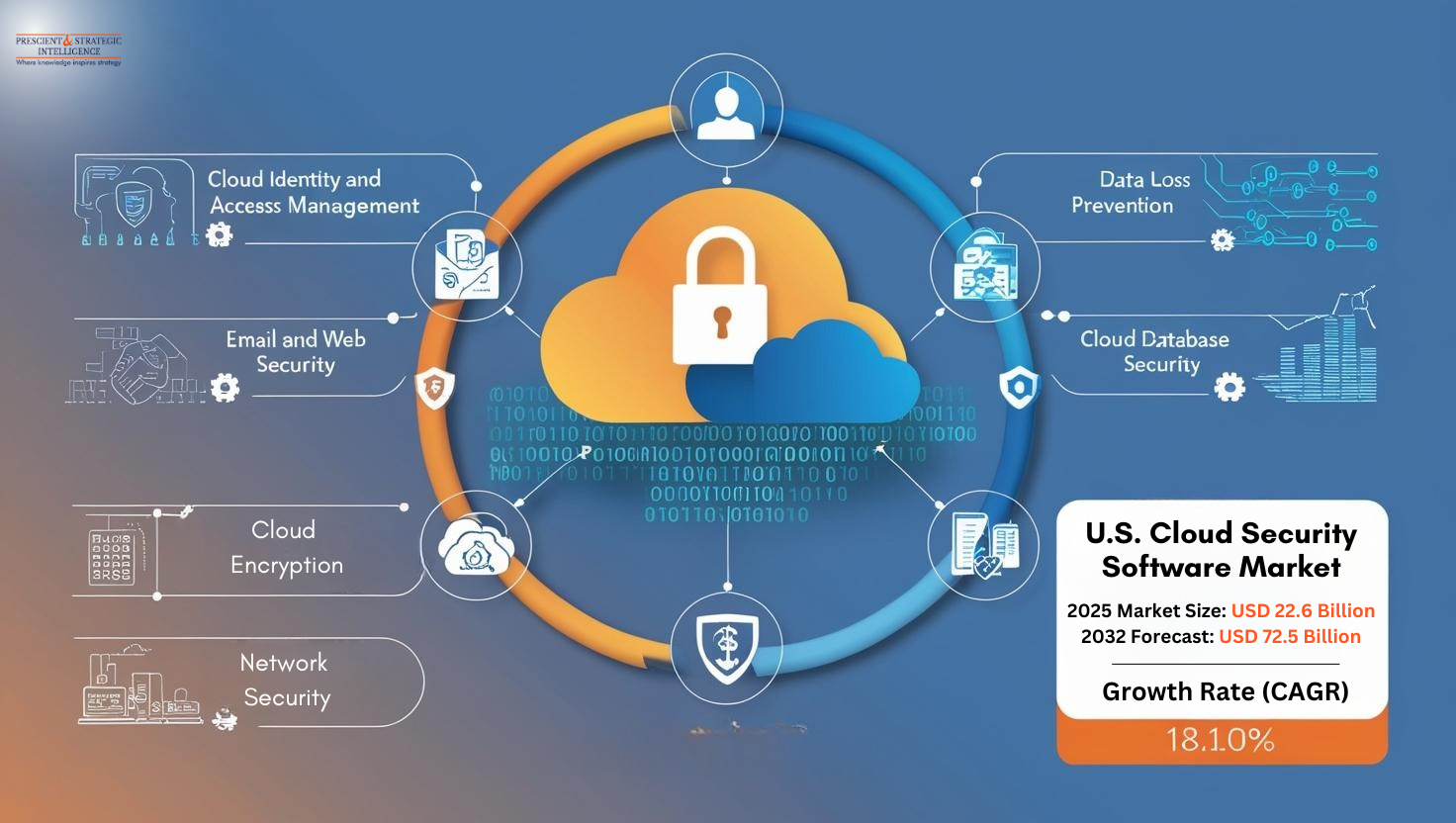
The U.S. cloud security market reached USD 19.3 billion in 2024 and is set for robust expansion, projected to grow at a CAGR of 18.1% from 2025 to 2032 and attain a value of USD 72.5 billion by 2032. This significant rise is largely driven by the rapid adoption of cloud-based data storage among businesses of all sizes, as organizations continue to shift away from traditional on-premises infrastructures. The shared and scalable nature of cloud platforms enables seamless data access and collaboration, but also introduces heightened security risks, which, in turn, amplify the demand for advanced cloud security solutions.
Moreover, widespread implementation of remote work and bring-your-own-device (BYOD) models is transforming enterprise workflows across the country. With more than 80% of U.S. companies currently practicing BYOD and nearly 41% of employees working either fully remotely or in hybrid settings, the exposure to cyber risks such as ransomware, malware, data leaks, and hacking is intensifying. As workers increasingly access sensitive cloud environments via personal devices, organizations are prioritizing robust protections to safeguard their data and maintain regulatory compliance. These evolving workstyles reinforce the urgency for dependable cloud security frameworks nationwide.
Download free report sample at: https://www.psmarketresearch.com/market-analysis/us-cloud-security-software-market/report-sample
Key Insights
- Identity and access management leads the market with USD 6.7 billion in revenue in 2024, driven by the need to authenticate users and regulate access efficiently across complex cloud infrastructures, especially as remote and hybrid workforces expand.
- Cloud encryption is the fastest-growing type due to its critical role in protecting sensitive cloud-hosted information. Encryption transforms data into unreadable code, accessible only to authorized users with the correct decryption key.
- Other types studied in the market include data loss prevention, e-mail and web security, database security, network security, and additional emerging categories addressing evolving cyber threats.
- Solutions dominate the market under the offering segmentation because essential security technologies such as CASB, CWPP, cloud detection and response, cloud infrastructure entitlement management, and posture management fall under this category.
- Services represent the faster-growing offering, with an 18.5% CAGR, due to the rising complexity of cloud deployments and shortage of in-house cloud security expertise, especially among SMEs, creating demand for managed services, consulting, training, and continuous monitoring.
- The BFSI sector holds a commanding 45% revenue share, attributed to high-value financial data, a stringent regulatory landscape, and increasing online transaction volumes. Incidents such as the October 2023 Mr. Cooper breach, which exposed 14.7 million customer records, further underscore the need for advanced cloud protection.
- Healthcare is the fastest-growing vertical, propelled by heavy digitization, high adoption of cloud-based electronic health records, and regulatory requirements such as HIPAA. In 2024 alone, over 90% of healthcare entities suffered a cyberattack, while 386 healthcare attacks were reported by October.
- Large enterprises dominate the market because of their vast data volumes and intricate IT ecosystems. Recent cyberattacks have targeted major U.S. institutions, including the Department of Defense (September 2024), Crowdstrike (July 2024), Boeing (October 2023), and MGM Resorts (September 2023).
- Small and medium enterprises are the faster-growing enterprise segment with an 18.4% CAGR, driven by accelerated cloud adoption, cost-saving goals, and the need to prevent financially devastating cyber incidents due to limited budgets and weaker industry influence.
- The West leads geographically with USD 8.7 billion in revenue, supported by the presence of major tech hubs such as Silicon Valley and Seattle, as well as high cloud adoption across IT, finance, and healthcare sectors.
- The South is the fastest-growing regional market due to increasing technology investments, rapid enterprise cloud adoption, and expansion of data centers. Several major Meta data centers—existing and upcoming—are located throughout Southern states including Alabama, Georgia, Louisiana, North Carolina, South Carolina, Tennessee, Texas, and Virginia.
- The competitive landscape is highly fragmented, featuring both large multinational providers and emerging regional players. Advancements in AI, ML, and zero-trust architectures are enabling new companies to enter the market with innovative security offerings.
- Leading U.S. cloud security companies include Amazon Web Services, Microsoft, Google, Cisco, IBM, Palo Alto Networks, Fortinet, Zscaler, Trend Micro, Broadcom, Qualys, and Check Point Software Technologies.
- Recent industry developments include Cisco’s USD 28 billion acquisition of Splunk in March 2024, Sophos’s USD 859 million acquisition of Secureworks in October 2024, and IBM’s launch of the IBM Security QRadar Suite in April 2023, enhancing cloud-native security capabilities for hybrid environments.
About P&S Intelligence
P&S Intelligence offers custom and syndicated market research and consulting services to clients across the globe. Our team of young and dynamic researchers, guided by mentors with years of experience, create data-rich reports tailored to the needs of MNCs as well as startups and SMEs. We remain in a perennial quest to offer exhaustive insights into every aspect of the market, allowing businesses of all sizes to seize even the smallest of opportunities and tackle even the biggest of challenges.
