
Global Smart Building Market to Reach USD 844.5 Billion by 2035Market Research ConsultantsUpdated on Mar 10, 2026 View more like this | Visit NYACK, NY | Contact Global Trends |
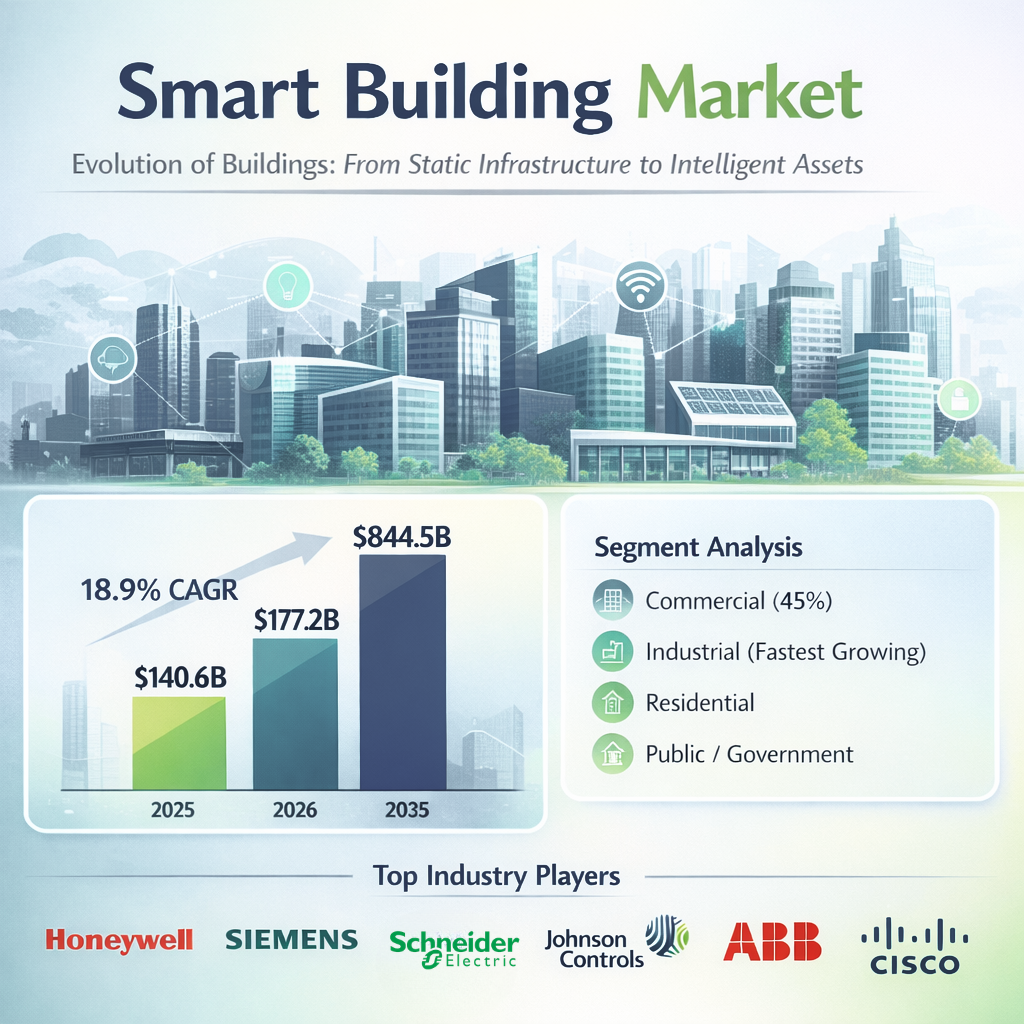
According to the market research report published by VynZ Research, the global smart building market is entering a transformative growth phase as buildings evolve into intelligent, data-driven assets designed to optimize energy use, safety, and operational efficiency. The market, valued at USD 140.6 billion in 2025, is estimated to reach USD 177.2 billion in 2026 and is projected to surge to USD 844.5 billion by 2035, expanding at a CAGR of 18.9% from 2026 to 2035.
The rapid expansion of the market is being driven by the increasing need for energy efficiency, sustainability compliance, and digital infrastructure integration across modern buildings. Governments, enterprises, and real estate developers are increasingly investing in intelligent technologies that transform traditional buildings into connected ecosystems capable of monitoring and optimizing operations in real time. With rising energy costs and stricter environmental regulations worldwide, smart building solutions are becoming a strategic priority for organizations seeking to reduce operational expenses while meeting sustainability targets.
Technological advancements in IoT, cloud computing, and artificial intelligence are further accelerating the deployment of smart building systems. These technologies enable predictive maintenance, centralized monitoring, automated energy management, and advanced security solutions across complex building environments. As occupants increasingly expect healthier, safer, and more personalized spaces, building operators are adopting digital solutions that enhance comfort, productivity, and operational transparency while improving long-term asset value.
Sustainability is emerging as a defining trend in the smart building market. Governments across the world are strengthening energy efficiency regulations and promoting building performance standards to reduce emissions from the built environment. Initiatives such as energy efficiency building codes, zero-emission building targets, and smart city development programs are encouraging the widespread adoption of building automation, energy analytics, and intelligent infrastructure solutions.
The urgent need to reduce carbon emissions is also playing a major role in market growth. Buildings account for a significant share of global energy consumption and energy-related emissions, prompting governments and organizations to invest in integrated energy management systems that optimize HVAC operations, lighting systems, and overall energy performance. Smart building technologies provide measurable insights that help organizations achieve sustainability targets while enhancing compliance with environmental regulations.
Download free report sample at: https://www.vynzresearch.com/chemicals-materials/smart-building-market/request-sample
Despite strong growth prospects, the market faces several challenges related to implementation costs, system integration complexity, and interoperability between multiple technologies. Retrofitting older buildings with smart systems often requires significant upfront investments and advanced technical expertise. In addition, the absence of standardized data exchange frameworks across regions can create integration barriers for building automation platforms. However, increasing government incentives, green financing initiatives, and performance-based energy management models are gradually reducing these barriers and supporting wider adoption.
The market also presents substantial opportunities as governments and institutions invest in smart infrastructure modernization programs. Public sector initiatives aimed at improving the energy efficiency of schools, hospitals, and government buildings are creating strong demand for intelligent building solutions. Furthermore, smart building technologies are enabling demand-response capabilities that help stabilize power grids and manage peak energy consumption, creating new opportunities for performance-based contracts and green financing models.
From a segmentation perspective, solutions dominate the market, accounting for the largest share due to their role in enabling energy management, building automation, security systems, and digital infrastructure. Meanwhile, services are emerging as the fastest-growing segment as organizations increasingly focus on long-term performance monitoring, system optimization, and lifecycle management of smart building technologies.
In terms of applications, commercial buildings hold the largest market share, driven by their high energy consumption, regulatory exposure, and demand for operational efficiency. Large office complexes, retail centers, and mixed-use developments are adopting advanced building management systems to improve sustainability and reduce operating costs. At the same time, industrial facilities are witnessing the fastest growth, as manufacturing plants and logistics hubs deploy intelligent systems to improve energy efficiency, safety, and predictive maintenance capabilities.
Regionally, North America currently leads the global market, supported by strong technology adoption, advanced digital infrastructure, and large commercial real estate portfolios. Europe remains a regulation-driven market, where strict sustainability targets and energy performance directives are accelerating building automation adoption. Meanwhile, Asia Pacific is emerging as the fastest-growing region, fueled by rapid urbanization, smart city initiatives, and government-led digital infrastructure investments across major economies such as China, Japan, and Singapore.
The competitive landscape of the smart building market is moderately fragmented, with global technology companies and specialized solution providers competing across automation, analytics, and digital infrastructure layers. Leading companies including Honeywell International Inc., Siemens AG, Schneider Electric SE, Johnson Controls International plc, ABB Ltd., and Cisco Systems, Inc. are focusing on AI-driven platforms, cloud-based building management systems, and integrated services to strengthen their market positions.
As buildings continue to evolve into digitally connected environments, smart building technologies are becoming essential infrastructure for modern cities. With growing emphasis on sustainability, energy optimization, and occupant wellbeing, the smart building market is expected to remain a key pillar of the global digital transformation and green infrastructure movement over the coming decade.
About VynZ Research
VynZ Research is a global market research and consulting firm providing actionable insights, analytics, and strategic advisory services to support informed business decision-making. The company specializes in delivering in-depth research across a wide range of industries, including Chemicals, Automotive, Transportation, Energy, Consumer Durables, Healthcare, ICT, and other emerging technologies.
VynZ Research helps enterprises identify growth opportunities, navigate market challenges, and develop effective business strategies. Our reports are built on robust market data and feature comprehensive analysis and quantification of key market drivers, industry dynamics, opportunities, challenges, threats, market share insights, and emerging trends and technologies across diverse industries.
Contact Us
VynZ Research
India: +91-996-028-8381
Toll-Free (U.S. & Canada): +1-888-253-3960
Email: [email protected]
Website: https://www.vynzresearch.com
While it requires higher upfront capital for hardware, Hybrid Cloud is often cheaper in the long run for predictable workloads by eliminating continuous public cloud rental fees.
