
Data Catalog Market Set for 20.9% CAGR as Enterprises Prioritize Data Governance and ComplianceMarket ResearchUpdated on Dec 8, 2025 View more like this | Visit NYACK, NY | Contact Global Trends |
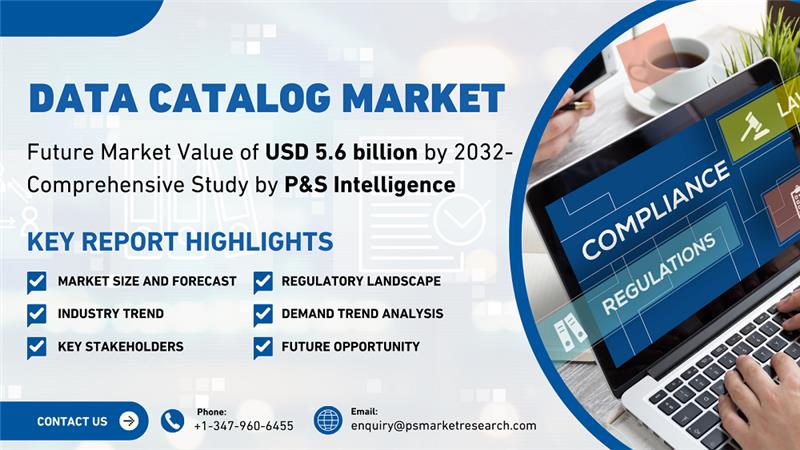
The global data catalog market is poised for robust expansion, generating USD 1.2 billion in revenue in 2024 and projected to surge to USD 5.6 billion by 2032, advancing at a remarkable CAGR of 20.9% from 2025 to 2032. This strong momentum is driven by the growing need among enterprises to streamline data management as organizations increasingly rely on data-driven decision-making. A data catalog enables users to organize, classify, and access relevant datasets more efficiently, helping them make strategic, analytics-backed decisions.
The adoption of data catalog solutions is further propelled by stringent data governance and privacy regulations, including GDPR, CCPA, and HIPAA. These frameworks compel organizations to strengthen their data governance practices, making data catalogs indispensable for improving compliance and ensuring secure data handling. In addition, the expanding volume of digital information—stemming from social media, IoT, and customer interaction channels—continues to solidify the role of data catalog platforms in ensuring consistency, accessibility, and structured management of enterprise data.
Supported by advanced capabilities such as automated dataset discovery, data usage tracking, and collaborative data curation, data catalogs have become essential for businesses to navigate the complexities of today’s data-rich environments. As enterprises face the challenge of data silos, inconsistent metadata, and rapid digitalization, data catalogs provide an efficient path toward governance, transparency, and strategic growth.
Download free report sample at: https://www.psmarketresearch.com/market-analysis/data-catalog-market/report-sample
Key Insights
- The solutions segment will account for a dominant 75% market share in 2024, driven by strong demand for streamlined data organization, enhanced accessibility, and governance-focused functionality across industries.
- Services will expand at a higher CAGR of 22% through 2032, as organizations increasingly depend on consulting, implementation, and support services to maximize their return on data catalog investments.
- Large enterprises will represent 60% of the market in 2024 due to their widespread data ecosystems spanning multiple departments, making centralized data repositories essential for operational efficiency.
- SMEs will register the faster CAGR of 23%, supported by the need for cost-efficient, simplified data management tools that enhance decision-making while reducing IT expenses.
- Cloud deployment will dominate with a 55% market share in 2024 and grow at a robust 21% CAGR, reflecting the preference for scalable, flexible architectures offering real-time access and lower infrastructure costs.
- Enterprise applications will hold 45% of the market in 2024, as businesses increasingly rely on integrated platforms covering CRM, SCM, BI, and e-commerce for better connectivity and operational optimization.
- Business intelligence tools will grow fastest, at a CAGR of 23%, owing to their ability to combine analytics, visualization, and mining functionalities for deeper insights and enhanced performance.
- Technical metadata will remain the larger category at 55% of the market, as organizations depend on detailed technical information such as structure, format, and processing parameters to deepen understanding and improve data utilization.
- Business metadata will expand at a CAGR of 20%, driven by the rising need for structured data migration strategies that ensure accurate and methodical data transfer.
- BFSI will contribute the largest vertical share of 25% in 2024, owing to the industry’s extensive and sensitive datasets that require precise management and governance.
- Retail and e-commerce will witness the highest CAGR of 21.5%, fueled by the rapid shift toward digital shopping experiences and the need to manage massive volumes of real-time consumer data.
- North America will lead with a 40% share in 2024, supported by a large digital-first enterprise landscape and strict data protection laws that drive catalog adoption across banking, healthcare, retail, and technology sectors.
- Europe will grow at the fastest regional CAGR of 23%, as the GDPR framework pushes organizations to adopt advanced cataloging solutions and cloud-based platforms to boost efficiency and compliance.
- The market remains fragmented, with key global players—such as IBM, Microsoft, Oracle, Collibra, Google, TIBCO, RightData, Alation, and Informatica—investing in mergers, collaborations, and product advancements to strengthen their competitive edge.
- Recent industry developments include data.world’s launch of its AI Context Engine in May 2024, Snowflake’s introduction of the Polaris Catalog in June 2024 to simplify multi-platform data access, and RightData’s next-generation DataMarket release in July 2023.
- Databricks announced in June 2024 that Unity Catalog, its unified governance solution, is now available for public procurement, reflecting broader industry efforts toward harmonized governance across multi-cloud and multi-format data environments.
About P&S Intelligence
P&S Intelligence offers custom and syndicated market research and consulting services to clients across the globe. Our team of young and dynamic researchers, guided by mentors with years of experience, create data-rich reports tailored to the needs of MNCs as well as startups and SMEs. We remain in a perennial quest to offer exhaustive insights into every aspect of the market, allowing businesses of all sizes to seize even the smallest of opportunities and tackle even the biggest of challenges.
