
Rare Earth Elements Market Size, Growth Analysis, Industry Trends & Forecast 2026-2034General BusinessUpdated on Aug 11, 2026 View more like this | Visit MONTCLAIR, NJ | Contact IMARC Group |
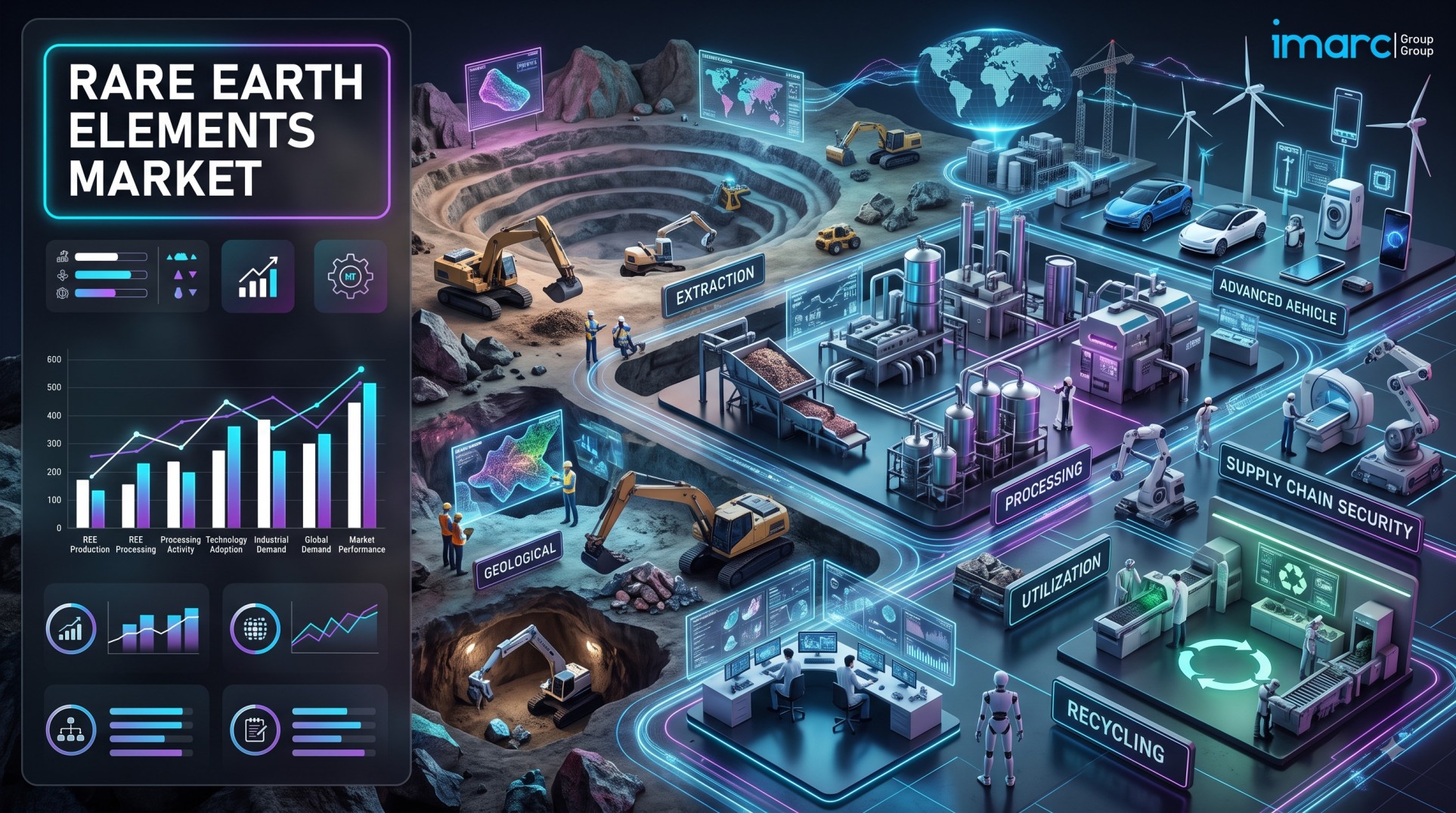
IMARC Group, a leading global market research and management consulting firm, has published its latest market intelligence report on the rare earth elements market. The global rare earth elements market size was valued at USD 14.03 Billion in 2025 and is projected to reach USD 41.15 Billion by 2034, exhibiting a CAGR of 12.32% during the forecast period 2026-2034, and the industry is witnessing steady expansion, driven by surging demand for permanent magnets in electric vehicles and wind turbines, expanding defense applications, rising consumer electronics consumption, tightening Western supply security mandates, and accelerating clean-energy build-out worldwide.
The market is experiencing strong growth momentum driven by the structural realignment underway across clean-energy electrification, defense reindustrialisation, and Western supply chain diversification. Magnets command the dominant application share, supported by EV traction motors, wind turbine generators, and consumer electronics miniaturisation, while China continues to lead global production through integrated mining, separation, and magnet manufacturing capacity concentrated in Inner Mongolia and Sichuan. Simultaneously, Japan, South Korea, and the United States are scaling parallel supply chains, with mine-to-magnet integration emerging as the defining competitive strategy across the industry.
How AI is Reshaping the Future of the Rare Earth Elements Market
- AI-Driven Ore Sorting and Extraction Efficiency: Machine learning platforms integrated into mining and beneficiation circuits are enabling rare earth producers to analyze ore composition, ground-penetrating radar data, and flotation performance in real time, allowing operators to optimize extraction yields, reduce reagent consumption, and improve recovery rates across hard-rock and ion-adsorption clay deposits without the guesswork that has historically characterized rare earth ore processing.
- Predictive Maintenance and Process Optimization in Separation Plants: AI-powered sensor networks deployed across solvent extraction and separation facilities are enabling rare earth processors to predict equipment failures, optimize reagent dosing, and reduce downtime across the hundreds of extraction stages required to isolate individual elements, improving throughput consistency and lowering the operating costs that have long made Western separation capacity less competitive than established Chinese benchmarks.
- Computer Vision Quality Control in Magnet Manufacturing: AI-driven inspection systems integrated into NdFeB magnet production lines are automating visual and dimensional quality checks for sintering consistency, coercivity performance, and coating integrity at speeds and precision levels manual inspection cannot match, reducing defect rates and supporting compliance with the exacting tolerances required by EV, defense, and aerospace customers across regulated markets in North America, Europe, and Asia Pacific.
Grab a sample PDF of this report: https://www.imarcgroup.com/rare-earth-industry/requestsample
Rare Earth Elements Market Trends and Drivers:
The global rare earth elements market is witnessing steady expansion, fuelled by the convergence of electric vehicle adoption, offshore wind capacity build-out, and structural shifts in Western procurement strategy that are repositioning rare earth supply as a matter of national industrial security rather than pure cost optimization. Electric vehicle sales are the foundational demand driver, with global EV sales surpassing 17 million units in a recent year and each traction motor consuming roughly 1 to 2 kilograms of neodymium-iron-boron magnet material. This demand scales directly with EV penetration, and automakers including General Motors have already secured long-term offtake agreements with integrated producers such as MP Materials to lock in supply ahead of anticipated shortfalls. The wind power sector reinforces this trajectory, with offshore turbines requiring between 600 and 1,000 kilograms of permanent magnets per megawatt of installed capacity and global wind capacity additions exceeding 117 gigawatts in a single recent year, a scale of deployment that is placing sustained pressure on neodymium, praseodymium, dysprosium, and terbium supply chains worldwide.
Supply chain concentration risk has emerged as both a commercial vulnerability and a policy catalyst that is actively reshaping investment flows across the industry. Roughly 85 to 90% of global rare earth refining and magnet manufacturing capacity remains concentrated in a single country, leaving Western automakers, electronics manufacturers, and defense contractors structurally exposed to export policy shifts and pricing volatility. According to the United States Geological Survey, rare earth elements have been formally classified among the critical minerals essential to national economic and security interests, a designation that is driving both regulatory attention and capital deployment toward diversified, allied-economy supply chains. The Defense Production Act in the United States and the Critical Raw Materials Act in the European Union are reinforcing this shift, with governments increasingly treating rare earth self-sufficiency as a strategic imperative rather than a purely commercial consideration.
The rapid scale-up of recycling and urban mining is unlocking an entirely new supply pathway that was previously marginal to the industry. End-of-life NdFeB magnet recycling, NiMH battery reclamation, and phosphor recovery are being commercialised by players including Solvay, Cyclic Materials, REEcycle, and Geomega Resources, offering rare earth oxide with a substantially lower carbon footprint than primary mining. Recycling-derived magnet feedstock is forecast to support a meaningfully larger share of total supply over the coming years, reducing dependence on primary extraction and offering OEMs a hedge against the price swings that have characterized rare earth oxide markets, with neodymium, dysprosium, and terbium prices having shown two to three times annual variation since the start of the decade.
Ask an analyst for customized report: https://www.imarcgroup.com/request?type=report&id=398&flag=E
Rare Earth Elements Industry Segmentation:
The report has segmented the market into the following categories:
Breakup By Application:
- Magnets
- Auto Catalysts
- Polishing Powders
- Glass
- Phosphors
- NiMH Batteries
- Diesel Engines
- Fluid Cracking Catalyst
- Others
Magnets account for the largest application segment, commanding roughly 31.2% of total demand, driven by their role in EV traction motors, wind turbine generators, and miniaturised consumer electronics, with NdFeB sintered magnets sustaining the highest unit-value rare earth demand globally as neodymium and praseodymium content continues to drive premium pricing across the segment. Auto Catalysts follow at approximately 16.4%, supported by sustained gasoline-engine emissions control requirements, while Polishing Powders hold roughly 11.8%, anchored by display-glass and semiconductor wafer manufacturing.
Breakup By Region:
- China
- Japan and Northeast Asia
- United States
China commands the largest regional share, at approximately 58.3% of global production, driven by integrated mining, separation, and magnet manufacturing capacity concentrated in Inner Mongolia and Sichuan, with the Bayan Obo complex alone accounting for a substantial share of global rare earth oxide output, supported by vertically integrated state players including China Northern Rare Earth and Shenghe Resources. Japan and Northeast Asia hold roughly 24.6%, anchored by Japan's magnet manufacturing base and Korea's electronics and EV assembly ecosystem, while the United States accounts for approximately 17.1%, benefiting from MP Materials' Mountain Pass mine, Energy Fuels' separation capacity, and Defense Production Act funding supporting domestic mine-to-magnet integration.
Competitive Landscape:
The report provides a comprehensive analysis of the competitive landscape in the rare earth elements market with detailed profiles of all major companies, including:
- Northern Rare Earth
- Lynas Rare Earths Ltd
- MP Materials
- Shenghe Resources Holding Co.
- Iluka Resources Limited
- JL MAG Rare-Earth Co., Ltd.
- Energy Fuels Inc.
- NEO
- Arafura Rare Earths
- Hastings Technology Metals Limited
What Does The Full Report Cover?
If you are tracking the rare earth elements market for investment decisions, market entry planning, competitive benchmarking, or strategic advisory, IMARC Group's report gives you everything in one place:
- Complete market sizing with revenue analysis covering the full projection period
- Quantified growth driver analysis with impact scoring across application and regional markets
- Sub-segment breakdowns for magnets, auto catalysts, polishing powders, glass, phosphors, and NiMH batteries with individual share data
- Regional data for China, Japan and Northeast Asia, and the United States
- Competitive profiles of 10 leading companies with strategic landscape assessment
- Porter's Five Forces, value chain analysis, and pricing intelligence
Latest technology trends covering mine-to-magnet vertical integration, recycling and urban mining, reduced-rare-earth magnet chemistries, and critical minerals trade policy frameworks shaping market competition across key regional markets
Recent News and Developments in Rare Earth Elements Market
February 2026: MP Materials selected a 120-acre site in Northlake, Texas, to build "10X," a new rare earth magnet manufacturing campus representing an investment exceeding USD 1.25 Billion, supported by a 10-year Pentagon offtake commitment. The facility is expected to expand the company's total domestic magnet production capacity meaningfully once fully operational.
March 2026: Lynas Rare Earths secured a preliminary supply agreement worth approximately USD 96 Million with the U.S. Department of Defense, anchored to output from its Lynas Advanced Materials Plant in Kuantan, Malaysia, the largest heavy rare earth separation facility outside China. The company also produced its first batches of separated samarium oxide ahead of schedule, reinforcing its position as the only major non-China producer of both light and heavy rare earth products.
June 2025: Lynas began commercial production of separated dysprosium and terbium oxide at its Malaysian facility, expanding its heavy rare earth product suite and strengthening its role as a reliable outside-China supply source for magnet manufacturers in Japan, Europe, and North America.
June 2024: Solvay and Cyclic Materials signed a supply agreement for recycled mixed rare earth oxide, with Cyclic Materials shipping recycled material from its Hub100 facility in Ontario, Canada to Solvay's La Rochelle plant in France for separation and reintegration into automotive, wind energy, and electronics applications, extending a partnership first formed in February 2023.
Note: If you require specific details, data, or insights that are not currently included in the scope of this report, we are happy to accommodate your request. As part of our customization service, we will gather and provide the additional information you need, tailored to your specific requirements. Please let us know your exact needs, and we will ensure the report is updated accordingly to meet your expectations.
Key Questions This Report Answers
- What is the current global rare earth elements market size and what is its growth outlook?
- Which application segment holds the largest share in the global rare earth elements market?
- What are the key drivers of global rare earth elements market growth?
- Which region dominates the global rare earth elements market and why?
- How are Western mine-to-magnet integration, recycling technology, and reduced-rare-earth magnet designs reshaping competitive strategies in the rare earth industry?
- Who are the top companies in the global rare earth elements market and what are their competitive strategies?
- What are the investment and market entry opportunities across magnet recycling, allied-economy processing, and defense-focused rare earth supply chains?
About Us:
IMARC Group is a global management consulting firm that helps the world's most ambitious changemakers to create a lasting impact. The company provides a comprehensive suite of market entry and expansion services. IMARC offerings include thorough market assessment, feasibility studies, company incorporation assistance, factory setup support, regulatory approvals and licensing navigation, branding, marketing and sales strategies, competitive landscape and benchmarking analyses, pricing and cost research, and procurement research.
Media and Sales Contact
IMARC Group
Email: [email protected]
United States: +1-201-971-6302
India: +91-120-433-0800
United Kingdom: +44-753-714-6104
