
Easy steps of successful Big Data executionBusiness SoftwareUpdated on Jul 30, 2016 View more like this | Visit LOS GATOS, CA | Contact Stream Analytix |
Leveraging Big Data can useful for every organization to progress competitiveness and financial outcomes. At the similar time, poorly consider and executed initiatives can lead to wasted investment and companies distraction. Not amazingly, the question of how best to reap the profit of Big Data is triggering comprehensive discussion in many organizations. What is best method in launching a Big Data planning & strategy?
Big Data is a set of actions for gathering and analyzing different kinds of data located within and outside the companies. The insights obtain from this analysis are used to increase business performance such as increase advertising quality & efficiency, make better supply chain responsiveness or service levels.
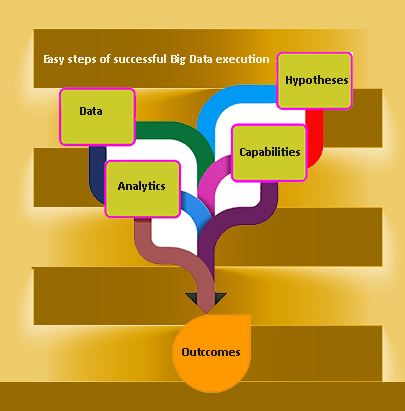
Almost big companies are already in to the Big Data business. The volume of data gathered is growing rapidly thanks to the digitization of virtually every customer and operational interaction. In our experimentation, the best way to get into Big Data is to start with a sensible roll out plan. This plans should consider 4 main elements:
Data
Any strategy and plan should start with a formal assessment of the relevant external and internal data, according to the big data 4 Vs: volume, variety, velocity and veracity. In many companies, data is siloed by business line; is not standardized and; it comes in various steps of perfection. Getting efficient data can be arduous and time-consuming. It may be desirable to outsource this data integration and clean up to specialist firms who can make it ‘analytics-ready.’
Hypotheses
It is simple to get side-tracked if you dive right into analysis without any strategic guideposts. Not all insights are equally important. Like other major initiatives, it is essential the Big Data effort links to business priorities and metrics. One way to do this is to start with a limited number of pilots based on specific hypotheses that directly impact strategic goals. Successful pilots can generate early wins that justify further investment, and can produce important insights around the business, as well as test out first generation capabilities.
Analytics
To effectively and efficiently mine the data, the team should carefully choose the appropriate analytical methodology or model for each business problem. The analytics will vary whether the goal is work-flow optimization (e.g., minimizing inventory levels, delivery times) or predictive analytics (e.g., anticipating consumer behavior, forecasting events). However, managers can easily over-speculate on solutions, choosing costly and complicated tools that require expensive or scarce talent. Judicious CIOs will take a “great is the enemy of good’ approach to choosing their models and depth of analysis.
Capabilities
Many IT environments are not conducive to quick or easy Big Data deployments. These infrastructures can be a heterogeneous mix of new and legacy hardware & software, lacking in data standardization and centralized control. To exploit Big Data opportunities, firms will need a unique combination of data experts, software tools and management capabilities as well as supporting governance practices. This capability should be developed with practicality in mind. Initially, CIOs could outsource Big Data needs to a cloud-based analytics service limiting upfront investment and accelerating time to value. Over the long term, the organization can look to develop world-class capabilities through employing specialized talent, bespoke software tools and private cloud architectures.
As with other strategic initiatives, a prudent way of getting into Big Data would be to start small and target actionable insights. Ongoing attention should be paid to ensure the learning are understood by the staff and implemented into existing work flows. Where necessary, new processes or practices may be needed to fully leverage the insights. Learning by doing will prompt managers to connect different analytical models together to address wider problems that span functions and business units.
Firms that are winning with Big Data are often the quickest out of the gate with a practical plan, based on a thorough understanding of their data, staff and IT environment. Big Data will be a game changer for companies who can deploy the right analytics and capabilities against their most pressing business issues.
Big Data is a set of actions for gathering and analyzing different kinds of data located within and outside the companies. The insights obtain from this analysis are used to increase business performance such as increase advertising quality & efficiency, make better supply chain responsiveness or service levels.
Almost big companies are already in to the Big Data business. The volume of data gathered is growing rapidly thanks to the digitization of virtually every customer and operational interaction. In our experimentation, the best way to get into Big Data is to start with a sensible roll out plan. This plans should consider 4 main elements:
Data
Any strategy and plan should start with a formal assessment of the relevant external and internal data, according to the big data 4 Vs: volume, variety, velocity and veracity. In many companies, data is siloed by business line; is not standardized and; it comes in various steps of perfection. Getting efficient data can be arduous and time-consuming. It may be desirable to outsource this data integration and clean up to specialist firms who can make it ‘analytics-ready.’
Hypotheses
It is simple to get side-tracked if you dive right into analysis without any strategic guideposts. Not all insights are equally important. Like other major initiatives, it is essential the Big Data effort links to business priorities and metrics. One way to do this is to start with a limited number of pilots based on specific hypotheses that directly impact strategic goals. Successful pilots can generate early wins that justify further investment, and can produce important insights around the business, as well as test out first generation capabilities.
Analytics
To effectively and efficiently mine the data, the team should carefully choose the appropriate analytical methodology or model for each business problem. The analytics will vary whether the goal is work-flow optimization (e.g., minimizing inventory levels, delivery times) or predictive analytics (e.g., anticipating consumer behavior, forecasting events). However, managers can easily over-speculate on solutions, choosing costly and complicated tools that require expensive or scarce talent. Judicious CIOs will take a “great is the enemy of good’ approach to choosing their models and depth of analysis.
Capabilities
Many IT environments are not conducive to quick or easy Big Data deployments. These infrastructures can be a heterogeneous mix of new and legacy hardware & software, lacking in data standardization and centralized control. To exploit Big Data opportunities, firms will need a unique combination of data experts, software tools and management capabilities as well as supporting governance practices. This capability should be developed with practicality in mind. Initially, CIOs could outsource Big Data needs to a cloud-based analytics service limiting upfront investment and accelerating time to value. Over the long term, the organization can look to develop world-class capabilities through employing specialized talent, bespoke software tools and private cloud architectures.
As with other strategic initiatives, a prudent way of getting into Big Data would be to start small and target actionable insights. Ongoing attention should be paid to ensure the learning are understood by the staff and implemented into existing work flows. Where necessary, new processes or practices may be needed to fully leverage the insights. Learning by doing will prompt managers to connect different analytical models together to address wider problems that span functions and business units.
Firms that are winning with Big Data are often the quickest out of the gate with a practical plan, based on a thorough understanding of their data, staff and IT environment. Big Data will be a game changer for companies who can deploy the right analytics and capabilities against their most pressing business issues.
