
Understanding Homogeneous MixturesApplied Sciences TechnologistsUpdated on Nov 21, 2021 View more like this | Visit India, UN | Contact Albert Dcoza |
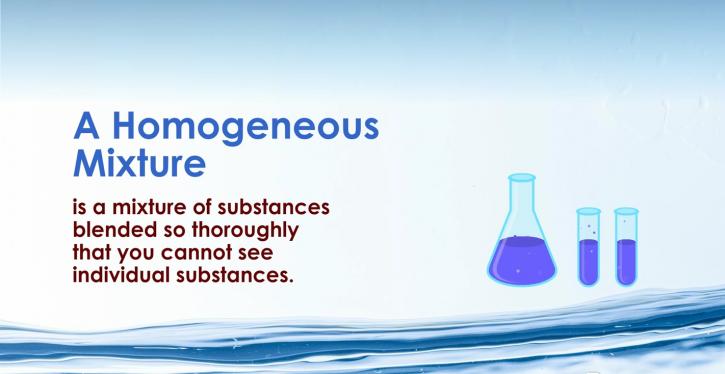
A heterogeneous mixture has substances arranged non-uniformly in it. In contrast, a homogenous mixture has substances, which are mixed in uniform proportion. To understand homogeneous mixture, we also need to learn about the homogeneous mixture classification.
What Are Homogeneous Mixture
The mixture in which the elements are mixed in a uniform composition is called a homogeneous mixture. A homogeneous mixture is a combination of all forms of matter like solid, liquid and gas.
However, Homogeneous mixtures have only one phase of matter, and they can be separated physically. Therefore, they can also be perceived as a liquid-gas mixture.
Examples
Air is a homogeneous mixture. Alloys are also a homogenous mixture as they include metals, such as brass, bronze, steel, sterling silver, combined in some specific ratio. But when more than one phase exists in an alloy, they are known as heterogeneous mixtures.
Common solutions like vodka, vinegar and washing liquids are homogeneous mixtures.
Some more examples of homogeneous mixtures are saltwater, detergents, a cup of tea, rainwater and many more.
Properties Of Homogeneous Mixture
- All the solutions are general examples of homogeneous mixtures.
- The size of the particle of any homogeneous mixture is less than a nanometer.
- A homogeneous mixture can be a combination of solid, liquid and gases and consists of only a single phase.
- Homogeneous mixtures are said to be monophasic, as they have a uniform composition.
- They contain multiple elements in their molecular form.
Classification Of Homogeneous Mixture
Homogenous mixtures are classified into different types. Let us study these types briefly.
Suspensions
Suspension is the solution in which the constituent particles are identifiable. These particles can be seen through the naked eyes. The mixture of particles of a suspension has a radius larger than 500 nanometers. This is why these particles are unable to pass from a filter paper, and thus they are separated through filtration.
You may have seen the painters mixing two paints before applying them to the wall. Have you ever asked them why they do so? This is because the paint is considered a suspension, and the particles are large, which means the particles can be seen easily.
When sand is mixed with water, the sand settles down in the water after some time. And to restore the state of suspension, you will have to mix them. Therefore, it can be regarded as suspension. Some other examples of suspension are muddy water, dough etc.
Solutions
A solution is a homogeneous mixture of two or more elements. The particles in the solution are very small and are less than one nanometer in diameter. It is very difficult to differentiate between the solute and the solvent because it is extremely small.
A few examples of solutions are salt or sugar mixed in water or aerated drinks like coca-cola, etc. A solution has two-component, which are as follows -
Solvent
A solvent is the major component of the solution. The solvent is a substance or a liquid in which the other components dissolve to form a solution. They are the larger component of the solution.
Some examples of solvents are water, ethanol, methanol, etc. in the saltwater solution, water acts as a solvent.
Solute
The solvent is another component of the solution. It is the minor component of a solution, which can be easily dissolved in the solvent to form a solution.
Examples of solutes are sugar, salt, oxygen, etc. In the saltwater solution. We can see that water is a solvent, and thus, the salt is solute, which gets dissolved in water and forms a saltwater solution. Likewise, carbon dioxide gas acts as a solute in cold drinks.
Colloids
Colloids are a mixture that contains different substances. Every substance in a mixture is divided into different small particles called colloidal particles. They remain suspended and dispersed throughout another substance, as they are very small and do not settle down because of gravity.
Colloids are electrically charged, and they cannot be seen through naked eyes, so microscopes are used to view them closely. Their size ranges from one nanometer to 1000 nanometers.
These solutions are further classified into different types like sol, foam, aerosol, emulsion and gel.
Sol - It is a colloidal system in which the dispersed particles are mostly solid, and the medium in which they are is liquid. For example, blood, ink, or mud.
Foam - The dispersed phase is mostly gas, and the medium is solid or liquid, such as bubble bath, fire extinguisher, shaving creams, etc.
Aerosol - A colloidal system with the solid or liquid in the dispersed phase, and the medium is gas like hairspray, deodorants, fog, etc.
Emulsion - The dispersed phase in the emulsion is a liquid, and the medium is another liquid—for example, milk, coffee, etc.
Gel - In this colloidal system, the dispersed phase is solid, and the medium is liquid. For instance, toothpaste, etc., are examples of gels.
A quick recap
Question 1. Is the homogenous mixture mainly liquid?
Answer. Homogenous mixtures have a uniform composition and can include all states of matter, i.e., solid, liquid and gas, in their composition.
Question 2. Can we separate the homogenous mixture?
Answer. Yes, homogenous mixtures can be separated using processes such as distillation and filtration.
Things To Remember
A homogenous mixture is a type of mixture that contains substances in a uniform composition. The homogenous mixture can be classified as Suspension, solution or colloids.
Moreover, a homogenous mixture has several properties, such as the size of the particle in a homogeneous mixture is less than a nanometer.
There are many such properties in a homogenous mixture, such as gel, milk and many more. Mixtures also have another type known as a heterogeneous mixture in which the constituent substances are not in uniform composition.
