
Low Density Polyethylene Market Size, Share and Growth 2025-2033General BusinessUpdated on Feb 5, 2026 View more like this | Visit India, UN | Contact IMARC Group |
Market Overview:
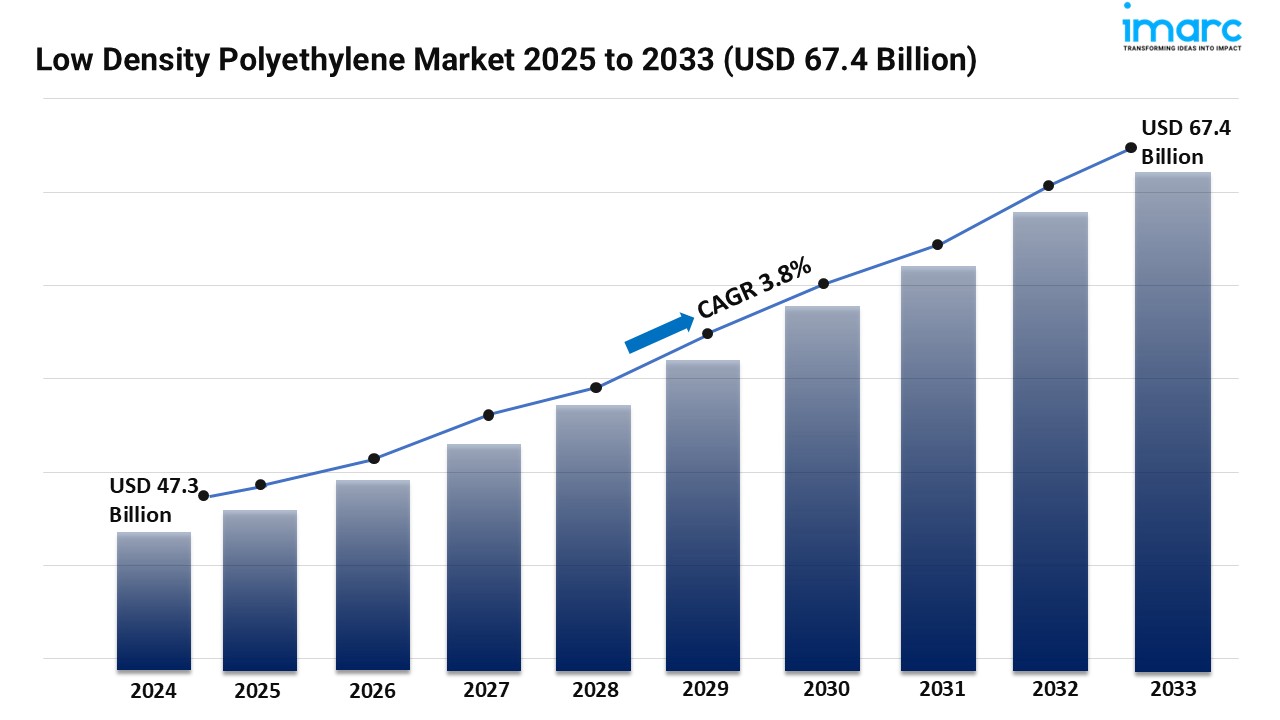
The Low Density Polyethylene Market is experiencing steady expansion, driven by Rising Demand for Flexible Packaging Solutions, Growth in Construction and Infrastructure Development, and Increasing Application in Agricultural Films. According to IMARC Group's latest research publication, "Low Density Polyethylene Market: Global Industry Trends, Share, Size, Growth, Opportunity and Forecast 2025-2033",The global low density polyethylene market size reached USD 47.3 Billion in 2024. Looking forward, IMARC Group expects the market to reach USD 67.4 Billion by 2033, exhibiting a growth rate (CAGR) of 3.8% during 2025-2033.
This detailed analysis primarily encompasses industry size, business trends, market share, key growth factors, and regional forecasts. The report offers a comprehensive overview and integrates research findings, market assessments, and data from different sources. It also includes pivotal market dynamics like drivers and challenges, while also highlighting growth opportunities, financial insights, technological improvements, emerging trends, and innovations. Besides this, the report provides regional market evaluation, along with a competitive landscape analysis.
Download a sample PDF of this report: https://www.imarcgroup.com/low-density-polyethylene-market/requestsample
Our Report Includes:
- Market Dynamics
- Market Trends and Outlook
- Competitive Analysis
- Industry Segmentation
- Strategic Recommendations
Growth Factors in the Low Density Polyethylene Market Industry:
- Rising Demand for Flexible Packaging Solutions
Low density polyethylene is extensively utilized in manufacturing various packaging materials, such as wrapping foils, foam, trays, and soft plastic bags required in the food industry. The growing demand for plastic containers made from LDPE in the food industry to pack baked goods, frozen products, and snacks is offering a favorable market outlook. LDPE is primarily used in producing packaging films, milk cartons, and dispensing bottles owing to its low reactive nature and food-grade quality. The rising number of quick service restaurants (QSRs), cafes, and fast-food chains selling flavorful dishes, along with home delivery services, is contributing to the growth of the market. According to the U.S. Census Bureau, online retail sales witnessed over 8% year-over-year growth in Q1 2024, creating consistent demand for flexible, lightweight, and durable packaging solutions. The material's flexibility, light weight, moisture barrier properties, and cost-effectiveness make it indispensable in film applications, laminated coatings, bottle caps, and flexible packaging materials.
- Growth in Construction and Infrastructure Development
The rising construction of hospitals, clinics, and nursing homes across the globe to provide quality healthcare to patients is propelling the growth of the market. LDPE sheets and films are used in the construction industry for vapor barriers, insulation, and protective covers because these materials offer durability and resistance to weather conditions. The construction industry's growing reliance on LDPE for insulation, protective coatings, and piping is contributing to market growth. Urbanization and increasing construction expenditure on infrastructure are anticipated to boost market growth over the forecast period. The construction sector is expected to be the fastest-growing market due to high demand, particularly in emerging economies. LDPE is capable of withstanding harsh climatic conditions and undergoing high thermal expansion, making it ideal for various construction applications. The Asia Pacific construction film segment is projected to grow at 6.5% CAGR through 2030, driven by rapid urbanization and infrastructure development.
- Increasing Application in Agricultural Films
There is an increase in the employment of LDPE films or plastic sheets used in the agriculture industry to maintain humidity and reduce the evaporation of water from the soil. The agricultural sector's increasing use of LDPE for greenhouse films, irrigation tubing, and mulch films is a significant growth driver. LDPE films help in maintaining optimal growing conditions by controlling temperature and moisture levels, which is essential for improving crop yields. The material's durability, moisture-proof properties, and ability to resist the effects of hazardous chemicals make it particularly suitable for agricultural applications. Growing demand from the construction industry owing to rising population, particularly in emerging economies such as India and Indonesia, is anticipated to drive demand for LDPE over the forecast period. The versatility of LDPE in various agricultural applications, combined with its cost-effectiveness, continues to support market expansion in the agriculture sector.
Key Trends in the Low Density Polyethylene Market:
- Increasing Adoption of Recyclable and Sustainable LDPE Solutions
The increasing demand for recyclable plastics to prevent soil and water pollution and reduce the negative impacts of plastics on human health is bolstering the market growth. EU regulation mandates 35% recycled content in plastic packaging by 2030, climbing to 65% by 2040. Producers are therefore scaling chemical processes that depolymerize post-consumer waste into feedstock suitable for food contact. Advanced chemical recycling methods now enable the recovery of monomers at near-virgin quality, revolutionizing the recycling process. The shift toward bio-based LDPE made from renewable feedstocks like sugarcane ethanol represents more than just a trend—it is a necessary strategic move. Braskem's Green PE clearly shows that large-scale commercial production of bio-based LDPE can succeed without sacrificing material quality. In February 2023, EFS Plastics used recycled low-density polyethylene to create a whole new product range named Nuera, demonstrating the industry's commitment to sustainability. The emphasis on sustainability is driving innovation within the market, fostering a competitive landscape where eco-conscious products gain traction.
- Technological Advancements in Production Processes
Innovations in production processes, such as advanced polymerization techniques, enhance the efficiency and quality of low-density polyethylene. In June 2024, Univation Technologies, LLC announced the introduction of its licensed technology platform, the UNIGILITY Tubular High-Pressure PE Process Technology, designed to enable the production of both low-density polyethylene and ethyl-vinyl acetate copolymer resins. LDPE is manufactured by free-radical polymerization of ethylene, wherein ethylene is cooled, compressed, and placed into a reaction vessel to initiate polymerization. Manufacturers frequently use LDPE sheets and films in packaging due to their affordability, flexibility, and moisture resistance. Modern production methods deliver consistent thickness, high clarity, and outstanding flexibility, making LDPE ideal for specialized applications like coatings and films. Artificial intelligence is also being used to automate quality control to ensure adherence to industry standards, which is crucial for testing the strength and puncture resistance of the polymers. These technological improvements continue to enhance product quality and production efficiency.
- Expanding Applications in Electronics and Healthcare Sectors
The rising adoption of LDPE in manufacturing wires, insulation cables, and various plastic parts of computer components is supporting the market growth. LDPE is gaining traction in the electrical and electronics sector due to its insulating properties. The rise in global electricity demand and the expansion of renewable energy grids are boosting the need for LDPE-insulated wires and cables. Asia Pacific held 40% of the global LDPE wires and cables market in 2023, reflecting the strong demand in the electronics sector. With rising hygiene concerns and an expanding healthcare sector, LDPE medical packaging is emerging as a high-potential segment. The material's sterility, moisture resistance, and sealing capabilities make it suitable for medical devices, disposable instruments, and surgical packaging. During the pandemic, single-use medical LDPE packaging gained prominence, and growing awareness and adherence to WHO guidelines around sterile barrier systems are accelerating this trend. Injection-molded LDPE products are preferred in the electronics industry for their insulation and chemical resistance properties.
We explore the factors propelling the low density polyethylene market growth, including technological advancements, consumer behaviors, and regulatory changes.
Leading Companies Operating in the Global Low Density Polyethylene Market Industry:
- BASF SE
- The Dow Chemical Company
- Exxon Mobil Corporation
- LyondellBasell Industries N.V.
- Saudi Basic Industries Corporation (SABIC)
- China Petroleum & Chemical Corporation (Sinopec)
- Borealis AG
- Braskem SA
- Chevron Phillips Chemical Company, LLC
- Lone Star Chemical
- Petkim Petrokimya Holding A.S.
- Total Petrochemicals & Refining USA, Inc. (TPRI)
- LG Chem Ltd.
- Formosa Plastics Corporation
- Qatar Petrochemical Company
Low Density Polyethylene Market Report Segmentation:
Breakup by Manufacturing Process:
- Autoclave Method
- Tubular Method
Autoclave Method exhibited a clear dominance in the market due to its versatility, low capital investment, ease of operation, and ability to produce LDPE with consistent quality and performance characteristics suitable for diverse applications.
Breakup by Feedstock:
- Natural Gas
- Naphtha
- Others
Natural Gas exhibited a clear dominance in the market due to its widespread availability, cost-effectiveness, and efficiency in ethylene production, which is the primary raw material for LDPE manufacturing.
Breakup by Application:
- Film and Sheets
- Extrusion Coatings
- Injection Molding
- Others
Film and Sheets exhibited a clear dominance in the market due to extensive utilization in packaging applications, superior moisture resistance, flexibility, and cost-effectiveness, making them the preferred choice for food packaging, agricultural films, and industrial wrapping.
Breakup by Region:
- Asia Pacific
- Europe
- North America
- Middle East and Africa
- Latin America
Asia Pacific dominated the global market due to rapid industrialization, growing utilization of electronic devices, increasing construction activities, rising demand for LDPE-based packaging material, and expansion of the e-commerce sector particularly in China and India.
Note: If you require specific details, data, or insights that are not currently included in the scope of this report, we are happy to accommodate your request. As part of our customization service, we will gather and provide the additional information you need, tailored to your specific requirements. Please let us know your exact needs, and we will ensure the report is updated accordingly to meet your expectations.
About Us:
IMARC Group is a global management consulting firm that helps the world's most ambitious changemakers to create a lasting impact. The company provide a comprehensive suite of market entry and expansion services. IMARC offerings include thorough market assessment, feasibility studies, company incorporation assistance, factory setup support, regulatory approvals and licensing navigation, branding, marketing and sales strategies, competitive landscape and benchmarking analyses, pricing and cost research, and procurement research.
Contact Us:
IMARC Group
134 N 4th St. Brooklyn, NY 11249, USA
Email: [email protected]
Tel No:(D) +91 120 433 0800
United States: +1-201-971-6302
