
India Popcorn Market Size, Statistics, Share Analysis and Research Report 2026–2034PopcornUpdated on Sep 16, 2026 View more like this | Visit India, UN | Contact IMARC Group |
India Popcorn Market: Industry Report 2026–2034
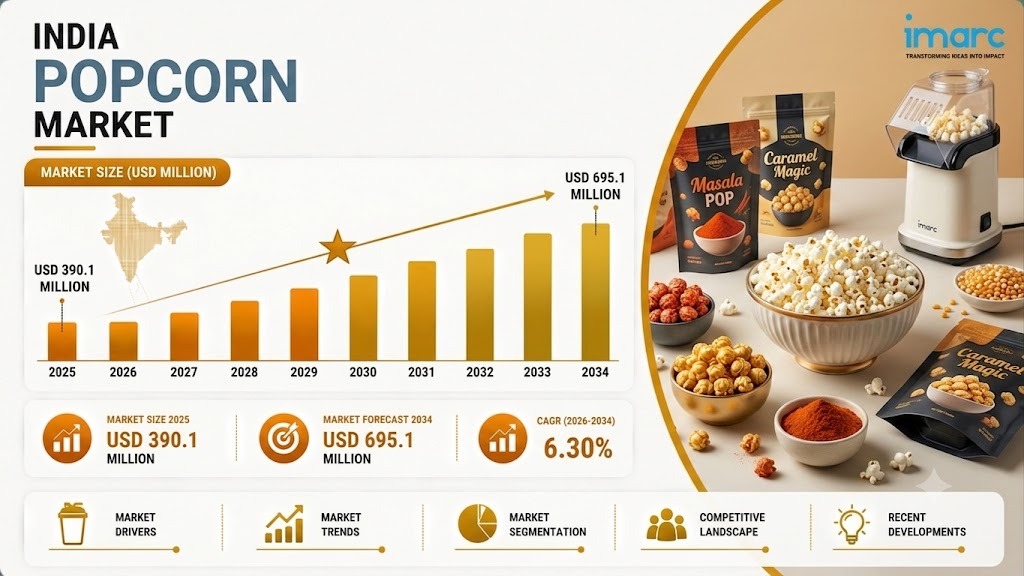
The India popcorn market size reached USD 390.1 Million in 2025 and is projected to reach USD 695.1 Million by 2034, exhibiting a robust compound annual growth rate (CAGR of 6.30%) during the 2026–2034 forecast period. The market is undergoing a massive structural transformation. Moving aggressively from a niche, cinema-dependent snack into a mainstream, high-volume fast-moving consumer goods (FMCG) category, popcorn is capitalizing on India's booming at-home entertainment culture, the rapid expansion of quick-commerce (Q-commerce), and a definitive consumer shift toward healthier, low-calorie snacking alternatives.
What Is the Size and Growth Forecast of the India Popcorn Market?
The market is exhibiting consistent and highly resilient expansion, fundamentally anchored by shifting consumer lifestyles, intense urbanization, and the exponential rise of digital at-home entertainment.
- Market Size in 2025: USD 390.1 Million.
- Market Forecast in 2034: USD 695.1 Million.
- Compound Annual Growth Rate (CAGR): 6.30% during the 2026–2034 forecast period.
- Underpinning Momentum: The aggressive democratization of gourmet flavors and the absolute ubiquity of quick-commerce delivery ensure a continuous, high-volume revenue pipeline across both metropolitan and Tier-2 retail landscapes.
What Are the Latest Emerging Trends in the India Popcorn Market?
- Explosion of Ready-To-Eat (RTE) Formats: While microwave popcorn maintains a solid household presence, the RTE segment is absolutely dominating retail expansion. Fueled entirely by the immediate convenience it offers, pre-popped, flavor-coated popcorn in highly portable packaging is capturing massive market share among young, on-the-go urban professionals.
- The Quick-Commerce (Q-Commerce) Impulse Buying Boom: The rapid expansion of 10-minute delivery platforms (like Zepto, Blinkit, and Swiggy Instamart) has fundamentally altered how snacks are purchased. The sheer density of urban dark stores has made premium RTE popcorn instantly accessible, driving massive volume in impulse-driven, late-night purchases aligned with movie streaming.
- Aggressive Democratization of Gourmet Flavors: Moving beyond basic salted or buttered varieties, consumers are demanding complex, artisanal flavor profiles. Brands are experimenting heavily with peri-peri, truffle, caramel sea salt, and localized cheese variants, effectively elevating popcorn from a standard snack to a premium indulgence.
- Advanced Packaging Technologies for Shelf-Life Extension: To combat India's humid climate—which rapidly degrades product crispness—manufacturers are widely adopting advanced nitrogen-flushed, multi-layered foil packaging, ensuring the product retains its texture throughout the supply chain.
Request a Sample Copy of this Report: https://www.imarcgroup.com/india-popcorn-market/requestsample
What Growth Factors Are Driving the India Popcorn Market?
- Booming OTT Penetration and "At-Home" Entertainment: The explosive growth of video streaming platforms (Netflix, Amazon Prime, Disney+ Hotstar) has drastically increased the frequency of at-home movie and binge-watching sessions. This structural shift in entertainment consumption directly drives inelastic, high-frequency demand for both microwave and ready-to-eat popcorn.
- Rapid Urbanization and Changing Dietary Lifestyles: India’s accelerating urbanization and the expansion of the corporate workforce are shifting dietary habits toward convenience. Popcorn—being a light, whole-grain, and highly satiating ready-to-eat snack—perfectly aligns with the needs of busy urban consumers seeking hassle-free, on-the-go food options.
- Expansion of Multiplexes into Tier-2 and Tier-3 Cities: Leading cinema chains (like PVR INOX and Cinepolis) are aggressively expanding their screen counts beyond metro areas into tier-2 and tier-3 cities. This physical expansion directly widens the top-of-funnel consumer base for high-margin, commercial popcorn consumption.
- Rising Disposable Incomes and Willingness to Upgrade: With growing per-capita incomes across urban clusters, consumers are highly willing to spend a premium on branded, hygienically packaged snacks over unorganized loose products. This upgrading behavior is the primary catalyst driving the volume of premium ready-to-eat formats.
- Increasing Household Microwave Penetration: The steady adoption of microwave ovens in middle-class Indian households acts as a fundamental hardware enabler for the microwave popcorn segment. The sensory appeal of freshly popped, warm popcorn at home continues to drive massive sales in modern retail and hypermarkets.
What Are the Key Challenges Facing the India Popcorn Market?
- Extreme Price Sensitivity in Mass Markets: While the urban premium segment is highly lucrative, attempting to scale branded, packaged popcorn into rural or tier-3 markets is exceptionally difficult. Mass-market consumers remain highly price-sensitive and frequently default to deeply entrenched, unorganized local vendors or cheaper traditional Indian savory snacks (namkeen).
- Raw Material Price Volatility: The market relies heavily on specific, high-quality hybrid corn kernels. Sudden fluctuations in domestic agricultural output due to erratic monsoons, combined with global supply chain disruptions affecting imported gourmet kernels, can quickly compress operating margins for manufacturers.
Explore the Full Report with Charts, Table of Contents, and List of Figures: https://www.imarcgroup.com/india-popcorn-market
Deep-Dive Segment Insights
The market is meticulously segmented to address varying preparation preferences, logistical sales channels, and final consumption avenues.
By Type
- Microwave Popcorn: A foundational segment heavily driven by the "ACT II" brand. It dominates standard household consumption due to its cost-effectiveness, extended shelf life, and the experiential appeal of hot, freshly popped snacks at home.
- Ready-To-Eat Popcorn: The fastest-growing segment. Driven by ultimate convenience and the proliferation of complex gourmet flavors (which are difficult to replicate in microwave formats), this segment perfectly aligns with modern impulse-buying behaviors and quick-commerce delivery.
By Distribution Channel
- Off-Trade: Commands the massive volume share of the market. This encompasses all retail consumption via supermarkets, hypermarkets, convenience stores (kiranas), and the rapidly booming online/e-commerce ecosystems where multi-pack purchasing is common.
- On-Trade: A highly lucrative, high-margin segment encompassing consumption at multiplexes, sports stadiums, theme parks, and cafes. While lower in total tonnage compared to off-trade, its value realization per gram is significantly higher.
By End Consumer
- Households: Represents the primary volume driver, heavily influenced by the rise of home-theater systems, OTT streaming habits, and the shift toward healthy, family-friendly evening snacking.
- Commercial: Driven entirely by institutional buyers, cinema chains, and large-scale event organizers catering to captive, out-of-home audiences.
By Region
- North India & West & Central India: These regions act as the primary growth engines. The dominance is fueled by a high concentration of multiplexes in the Delhi-NCR and Mumbai-Pune corridors, dense urban populations with high disposable incomes, and the heaviest penetration of 10-minute grocery delivery apps.
- South India & East India: Represent critical auxiliary markets. South India exhibits rapid adoption driven by its massive, deeply entrenched cinema culture and tech-centric urban hubs like Bengaluru and Hyderabad, while East India scales steadily through modern retail expansion.
Competitive Landscape & Key Player Positioning:
Covering an in-depth analysis of the competitive landscape, market structure, key player positioning, competitive dashboards, top winning strategies, and detailed profiles of all major industry participants you will gain access to all these exclusive insights within the full research report.
Recent Developments
- January 2026 (Major FMCG Acquisition): In a landmark deal reshaping the premium snacking landscape, FMCG giant Marico Limited acquired a massive majority stake (over 90%) in Zea Maize (the parent company of gourmet popcorn brand 4700BC) from multiplex operator PVR INOX for approximately INR 226.8 crore (USD 24.7 million). This strategic acquisition allows Marico to aggressively scale 4700BC across its massive national FMCG distribution network.
- February 2026 (ACT II Parent Rebranding & Profitability Surge): Agro Tech Foods Limited—the parent company behind India’s flagship popcorn brand, ACT II—officially rebranded as Sundrop Brands. In Q3 FY26, the company reported a massive 80% jump in its consolidated EBITDA. This profitable growth was driven largely by a blistering 36% expansion in its ready-to-eat formats, solidifying ACT II's dominance against emerging gourmet challengers.
Customization Note: If you require any specific information not covered within this report's scope, we will provide it as part of the customization.
Request Report Customization: https://www.imarcgroup.com/request?type=report&id=10082&flag=E
Frequently Asked Questions (FAQs)
Q1. What is the current size of the India popcorn market?
The India popcorn market size was valued at USD 390.1 Million in 2025.
Q2. What is the projected market size by 2034 and the growth rate?
The market is projected to reach USD 695.1 Million by 2034, exhibiting a solid compound annual growth rate (CAGR of 6.30%) during the 2026–2034 forecast period.
Q3. Which popcorn type is experiencing the most rapid growth?
While Microwave Popcorn holds massive foundational volume, Ready-To-Eat (RTE) Popcorn is the fastest-growing segment, heavily fueled by gourmet flavor innovations and the convenience of quick-commerce delivery.
Q4. What is the difference between On-Trade and Off-Trade distribution?
Off-Trade refers to retail channels like supermarkets, kirana stores, and online delivery apps where consumers buy popcorn for home consumption. On-Trade refers to out-of-home commercial venues like multiplexes, theaters, and sports stadiums.
Q5. How has the OTT boom affected the popcorn market?
The massive rise of streaming platforms (like Netflix and Amazon Prime) has structurally shifted entertainment into the home. This "at-home" viewing culture acts as a direct catalyst for the industry, generating highly consistent, inelastic demand for both microwave and ready-to-eat popcorn.
