
India Interior Design Market Research Report, Industry Trends and Forecast 2026–2034Interior Designers & DecoratorsUpdated on Aug 25, 2026 View more like this | Visit India, UN | Contact IMARC Group |
Market Overview & Summary
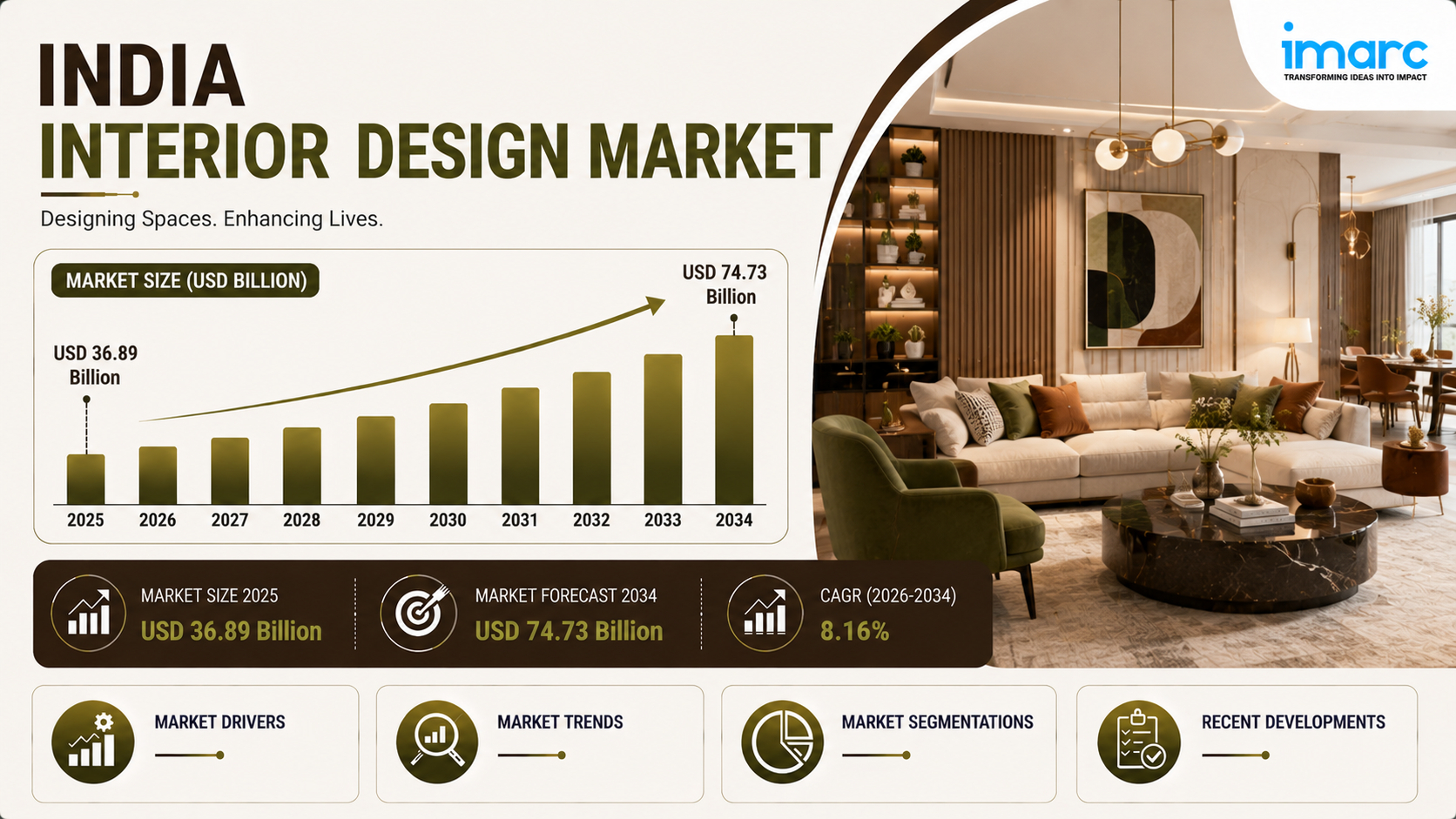
The India interior design industry size reached USD 36.89 Billion in 2025. Looking forward, the market is projected to reach USD 74.73 Billion by 2034, exhibiting a robust compound annual growth rate (CAGR) of 8.16% during the 2026-2034 forecast period. The industry is currently witnessing strong momentum as rapid urban expansion, elevating living standards, and inflating consumer expenditure capacities fundamentally reshape the demand for well-designed spaces. The market is aggressively moving away from fragmented, unorganized local contractors toward tech-enabled, organized platforms that offer end-to-end design, 3D visualization, and execution. Consumers increasingly seek customized, visually refined, and highly functional interiors that reflect personal taste, cultural nuances, and sustainable living practices.
Market Size & Forecast:
- Market Size (2025): USD 36.89 Billion
- Projected Market Size (2034): USD 74.73 Billion
- CAGR (2026 - 2034): 8.16%
- Leading Regional Market: North India (29.0% Share in 2025)
Key Market Trends:
- Integration of Smart Home Technologies & Contextual AI:
The adoption of smart home technology is structurally reshaping interior design preferences. Consumers are increasingly demanding the seamless integration of IoT-enabled devices, automated lighting, climate control, and smart security systems into their living spaces. Moving into 2026, "Contextual AI" is becoming prominent, where invisible tech like sensors pre-wired during renovation to mimic circadian rhythms is seamlessly blended into the architectural layout without compromising aesthetics.
- Transition to "Broken-Plan" and Multi-Purpose Living:
The era of completely open-plan floor layouts is gradually fading. With hybrid work remaining common, consumers are pivoting toward "broken-plan" living. Interior designers are heavily utilizing modular dividers, glass partitions, sliding panels, and movable bookshelves to create quiet, segmented zones for work or study, optimizing spatial efficiency in compact urban apartments.
- Demand for Sustainable and Eco-Friendly Solutions:
Environmental consciousness is driving a massive shift toward biophilic design. Consumers are actively opting for FSC-certified reclaimed wood, bamboo, jute, clay-based and low-VOC paints, and recycled terrazzo. Furthermore, passive cooling techniques using lime plaster walls and stone floors are becoming standard considerations for energy efficiency.
- Curved Architecture and Tactile Textures:
The market is seeing a major aesthetic shift toward curved architecture and tactile surfaces. Stiff doorframes and sharp edges are being replaced by arched walkways, scalloped edges, and rounded shelving. Smooth, sterile surfaces are out, making way for raw, tactile finishes like lime-wash, microcement, and fluted timber panels that invite touch.
- Growth of Tech-Enabled Customization (3D & AR):
Tech-enabled interior platforms are leveraging data-driven insights and augmented reality (AR) to deliver highly personalized design recommendations. These companies offer immersive 3D visualization tools that allow clients to virtually experience their bespoke furniture and tailored layouts before execution, significantly boosting customer confidence and conversion rates.
Grab a sample copy of this report: https://www.imarcgroup.com/india-interior-design-market/requestsample
Strategic Market Dynamics:
Growth Drivers:
- Surging Real Estate Investments and Luxury Housing:
Inflating consumer expenditure capacities and the rapid development of premium and luxury residential projects in major urban clusters (like Bangalore, Delhi-NCR, and emerging hubs like Jaipur) serve as the primary catalyst driving high-value interior design contracts.
- Rising Nuclear Family Formations and Urbanization:
The demographic shift toward nuclear families relocating to Tier-1 and Tier-2 cities drives consistent, high-volume demand for space-optimizing interior solutions tailored for compact 1 BHK, 2 BHK, and 3 BHK apartment configurations.
- Government Infrastructure Initiatives:
Aggressive state interventions, such as the PM Awas Yojana and the Smart Cities Mission, are heavily boosting real estate development. Furthermore, the development of commercial buildings, co-working spaces, and multiplexes is generating substantial B2B demand for commercial interior design services.
- Formalization via Organized D2C Platforms:
The aggressive expansion of organized, digital-first interior design startups has democratized access to professional design. By offering guaranteed delivery timelines, flat warranties, and transparent pricing models, these platforms have successfully converted millions of buyers who previously relied on informal carpenters.
- Influence of Global Aesthetics via Social Media:
The deep penetration of visual platforms like Instagram and Pinterest exposes Indian consumers to global architectural trends, fostering aspirational demand for theme-based, curated, and highly photogenic living spaces.
Market Restraints:
- Intense Price Competition from the Unorganized Sector: Despite rapid formalization, the Indian interior design market remains heavily fragmented. Thousands of local, unorganized contractors and independent carpenters operate with minimal overheads, offering localized, low-cost alternatives that continuously pressure the profit margins of organized corporate players.
- Supply Chain and Skilled Labor Bottlenecks: Delivering bespoke, premium interiors on strict timelines requires a highly efficient supply chain and specialized artisan labor. Disruptions in the procurement of imported materials (like premium Italian marble or specialized hardware) and a shortage of highly skilled execution teams often lead to project delays and cost overruns.
Explore the Full Report with Charts, Table of Contents, and List of Figures: https://www.imarcgroup.com/india-interior-design-market
Deep-Dive Segment Insights:
Decoration Type Insights:
- New
- Renovation
Key Insight: New decorations strictly dominate the market, commanding a 56.0% share in 2025. This segment's leadership is directly anchored by the continuous handover of new residential apartment projects and fresh commercial office build-outs across expanding urban peripheries.
End User Insights:
- Residential
- Commercial
Key Insight: The Residential segment is the undisputed leader, accounting for a massive 60.0% share in 2025. This is driven by homeowners seeking personalized living spaces, the booming home-improvement sector, and the cultural significance placed on homeownership in India. The Commercial segment follows, heavily sustained by the resurgence of co-working spaces and experiential retail.
Region Insights:
- North India
- West and Central India
- South India
- East India
Key Insight: North India leads the regional market with a 29.0% share in 2025. This dominance is underpinned by massive residential real estate development across the Delhi-NCR cluster, high disposable incomes in Punjab and Haryana, and the rapid rise of premium housing markets in cities like Jaipur. South India remains a highly lucrative secondary market, driven by tech-sector affluence in Bangalore and Hyderabad.
Competitive Landscape & Key Company Insights:
The India interior design market is a highly dynamic ecosystem characterized by a fierce battle between legacy furniture manufacturers, paint conglomerates expanding into home décor, and venture-backed tech-enabled design platforms. Competition is intensely fought on the basis of project delivery speed, transparent pricing, 3D technology integration, and post-installation warranties. To secure market share, leading tech platforms are establishing massive omni-channel "experience centers" across Tier-1 and Tier-2 cities to bridge the gap between digital design and physical material selection.
Recent News and Developments:
- Livspace Forecasts 2026 Shift to "Minimal Maximalism" (January 2026): Leading interior platform Livspace released its 2026 trend forecast, noting a distinct market maturation toward "minimal maximalism." Rather than loud colors or heavy patterns, the focus has shifted to rich textures, artisan craftsmanship, and sculptural décor layered over warm, neutral palettes, emphasizing longevity over fast décor.
- HomeLane Highlights "Contextual AI" and Renovation Trends (April 2026): HomeLane aggressively pushed its tech-integrated design services, highlighting a major pivot toward "Contextual AI" and planetary consciousness in home renovations. The brand noted a rising consumer demand for "invisible tech," where AI-driven lighting and climate sensors are pre-wired during the demolition phase, alongside a growing preference for solar-integrated balcony railings and "broken-plan" quiet zones.
- Expansion of Regional Premium Markets (Mid-2026): Industry evaluations highlighted the rapid decentralization of luxury interior demand. Cities like Jaipur emerged as some of India's fastest-growing premium-housing markets in 2026, absorbing a disproportionate share of high-end, bespoke interior design services and prompting organized studios to rapidly expand their geographic footprints beyond traditional Tier-1 metros.
Customization Note: If you require any specific information not covered within this report's scope, we will provide it as part of the customization.
Request Report Customization: https://www.imarcgroup.com/request?type=report&id=6173&flag=E
Frequently Asked Questions (FAQs):
Q1. What is the India interior design market size in 2025?
Ans. The India interior design market size was valued at USD 36.89 Billion in 2025.
Q2. What is the projected market size and growth rate by 2034?
Ans. The market is projected to reach USD 74.73 Billion by 2034, exhibiting a robust compound annual growth rate (CAGR) of 8.16% during the 2026-2034 forecast period.
Q3. Which end-user segment dominates the market?
Ans. The Residential segment holds the dominant market position, capturing a 60.0% share in 2025, fueled by rising disposable incomes, urbanization, and a strong consumer desire for personalized home environments.
Q4. What are the major factors driving the market's growth?
Ans. Growth is primarily driven by massive real estate investments, the rapid formalization of the industry via tech-enabled platforms, increasing nuclear family formations, and shifting preferences toward smart, automated, and theme-based interior designs.
Q5. Which region holds the largest market share in India?
Ans. North India commands the largest regional share at 29.0% in 2025, heavily supported by the dense concentration of luxury and premium residential developments across the Delhi-NCR region.
