
India Foreign Exchange Market Valuation to Reach USD 68.80 Billion by 2034, at 8.4% of CAGRForeign Trade & International BanksUpdated on May 19, 2026 View more like this | Visit India, UN | Contact Market Reseach Expert |
According to IMARC Group's report titled "India Foreign Exchange Market Size, Share, Trends and Forecast, 2026-2034", the report offers a comprehensive analysis of the industry, including foreign exchange market share in India, its growth, trends, and regional insights.
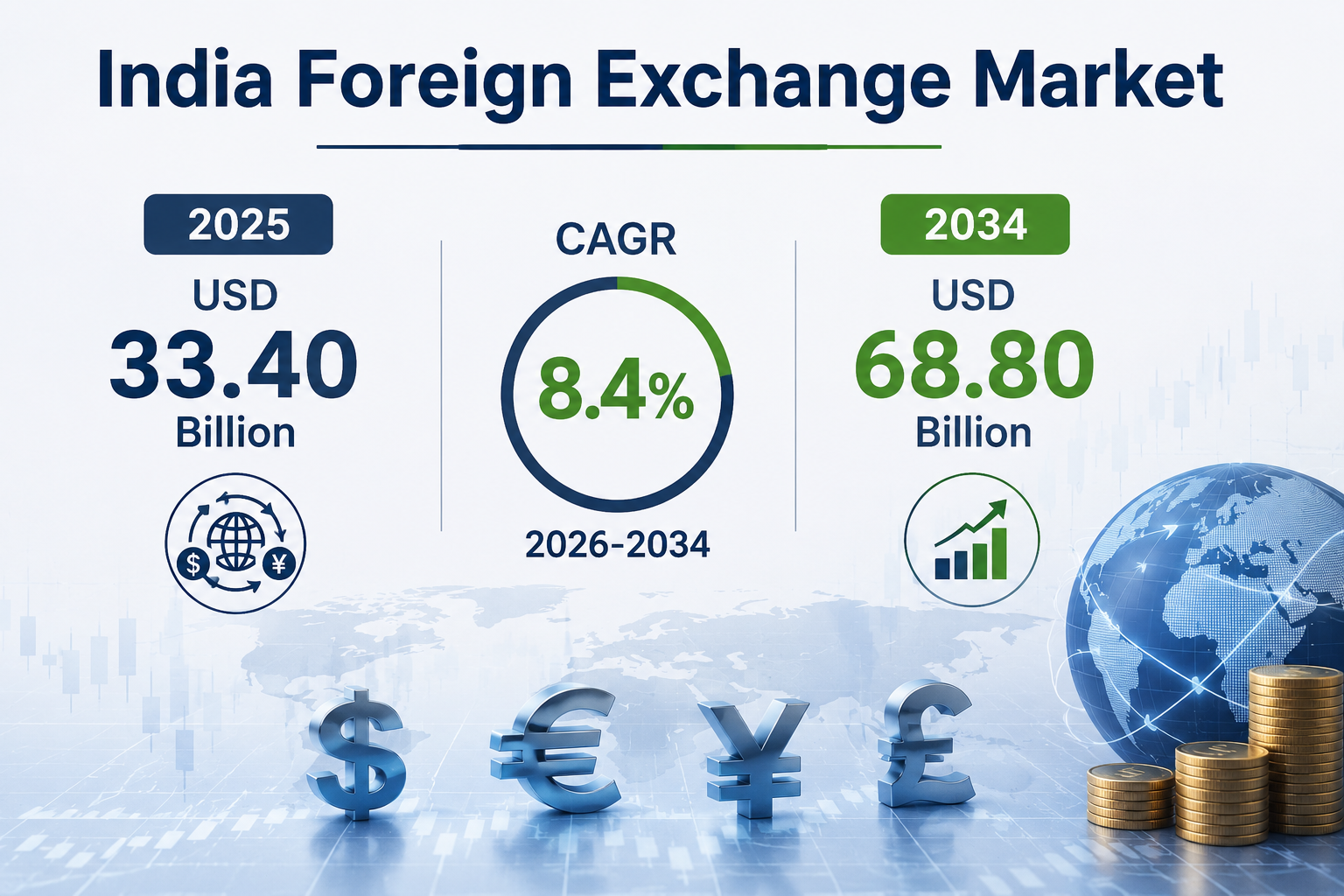
The foreign exchange market in India was valued at USD 33.40 Billion in 2025, expected to reach USD 68.80 Billion by 2034, at a CAGR of 8.4% during the forecast period 2026-2034. India's forex market is at the cusp of a fundamental structural shift from traditional bank-dominated currency dealing to digitally-enabled, algorithm-driven trading platforms that offer real-time pricing, seamless execution, and lower transaction costs. This market is not speculative; it is being driven by hard cross-border trade flows, rising foreign direct investment, and progressive RBI policies supporting INR internationalization.
Market Key Statistics:
- Current Market Size (2025): USD 33.40 Billion
- Projected Market Size (2034): USD 68.80 Billion
- CAGR: 8.4%
- Forecast Period: 2026-2034
- Reporting dealers hold the largest counterparty share at 42.1% in 2025, driven by their role as primary liquidity providers and interbank market makers.
- Currency swaps lead the type segment with a 40.3% share, reflecting robust hedging demand for long-term currency risk management.
- Non-financial customers represent the fastest-growing counterparty segment at ~9.6% est. CAGR, fueled by increasing outbound investment activity.
- North India is the leading regional market with a 34.0% share backed by concentration of corporate headquarters and authorized dealers in Delhi NCR.
India Foreign Exchange Market Trends & Future Outlook
- Accelerating Digital Forex Platform Adoption: User-friendly mobile applications and seamless onboarding have democratized forex trading. A tech-savvy investor base is actively trading major INR pairs using advanced analytical tools and live price feeds, shifting market depth away from exclusive institutional dominance. This democratization is adding breadth and liquidity to a market traditionally dominated by institutional players.
- INR Internationalization and Cross-Currency Expansion: The central bank's push toward INR-denominated trade settlement is creating new demand for INR cross-currency hedging instruments. This structural shift is expected to significantly expand the size of India's forex market as bilateral trade in INR gains traction across emerging economies, with active transactions already taking place across key trading partners.
- Surge in NRI Remittances and Deposit Growth: India sustained its position as the world's largest remittance recipient in 2024. NRI deposits rose to USD 158.94 Billion in outstanding balances by August 2024, representing a powerful structural forex supply driver that supports rupee stability and market liquidity, strengthening the forex supply side.
- Corporate Treasury Sophistication and Hedging Innovation: Indian corporations especially in IT services (USD 210 Billion estimated exports in FY25), pharmaceuticals, and manufacturing are developing sophisticated forex treasury strategies. Adoption of structured options, cross-currency swaps, and dynamic hedging programs is driving FX options segment growth as companies adopt more advanced treasury practices.
- AI-Powered Forex Analytics and Algorithmic Trading: The integration of artificial intelligence and machine learning into forex price discovery, execution algorithms, and risk analytics is rapidly transforming India's institutional forex landscape. Leading banks and technology-enabled brokers are deploying AI-driven trading desks, compressing spreads and improving execution quality for corporate clients.
- RBI Policy Support and Framework Modernization: The Reserve Bank of India's proactive monetary policy management, currency stabilization interventions, and progressive opening of the forex ecosystem continue to strengthen market depth and liquidity. The central bank's expanded approval for INR-based trade settlement with multiple countries is creating structural demand for INR-denominated hedging instruments.
Evaluate Market Opportunity with the Business Sample Report
Why Invest in the India Foreign Exchange Market - Key Growth Drivers
- Rising International Trade and Cross-Border Transactions Driving Forex Demand: India’s growing export-import activities and increasing integration with global markets are significantly boosting demand for foreign exchange services. Businesses involved in international trade increasingly require currency conversion, trade settlements, and hedging solutions, creating steady growth opportunities for forex market participants.
- Rapid Digitalization Making Forex Services More Accessible: The expansion of digital banking, mobile trading applications, and online forex platforms is simplifying foreign exchange transactions for both businesses and individual consumers. Easy access to real-time exchange rates, digital payments, and app-based currency services is encouraging wider adoption of organized forex platforms across India.
- Strong Inflow of Remittances Supporting Market Expansion: India remains one of the world’s largest recipients of remittances from overseas workers and NRIs. These large foreign currency inflows strengthen forex reserves, improve market liquidity, and create continuous demand for currency exchange and remittance services across the country.
- Growing Overseas Travel and International Education Increasing Currency Exchange Needs: Rising disposable incomes and expanding middle-class aspirations are leading to higher spending on international travel, overseas education, and global business activities. This trend is increasing demand for foreign currency exchange services, prepaid forex cards, and international payment solutions.
Key Market Challenges
- Regulatory Complexity and Compliance Burden: India's forex market operates under extensive FEMA and RBI regulations, including capital account restrictions, documentation requirements, and transaction limits. These compliance demands increase operational costs for smaller financial institutions and restrict product innovation compared to more liberalized global forex markets.
- INR Currency Volatility and External Macro Risks: The Indian rupee remains vulnerable to global risk-off sentiment, shifts in US monetary policy, and fluctuations in crude oil prices due to the country's high import dependence. Periods of sharp currency depreciation tend to dampen corporate participation in the forex market while simultaneously increasing the cost of hedging exposures.
- Cybersecurity and Platform Risks in Digital Forex: The rapid growth of digital forex trading platforms has expanded the attack surface for cybersecurity threats. Regulatory lapses, platform outages, or fraud incidents can damage retail investor confidence and slow the democratization of forex market participation.
Market Segmentation Breakdown
By Counterparty — Reporting Dealers Lead Market Expansion
Reporting dealers dominate with a 42.1% share in 2025, underpinned by their role as primary liquidity providers and execution agents for institutional and corporate clients. These entities - primarily scheduled commercial banks with RBI authorization - function as the primary liquidity backbone of the market, executing interbank trades, corporate currency purchases, and institutional hedging transactions.
By Type — Currency Swaps Power the Market
Currency swaps dominate the type segmentation at 40.3% share in 2025, driven by corporate demand for long-dated currency and interest rate risk management. Indian companies with external commercial borrowings (ECBs) denominated in USD and EUR routinely use cross-currency swaps to convert fixed foreign currency liabilities into INR-equivalent obligations, managing both exchange rate and interest rate exposure simultaneously.
By Region — North India Leads Adoption
North India commands 34.0% of India's total forex market revenue in 2025, anchored by the concentration of corporate headquarters and authorized dealers in New Delhi and NCR. The National Capital Region hosts the largest concentration of corporate headquarters, public sector undertakings, and government-linked financial entities, generating deep and consistent forex transaction volumes across all counterparty categories.
Competitive Landscape - By IMARC GROUP
Gain comprehensive access to an in-depth analysis of the competitive landscape, including market structure, key player positioning, competitive dashboards, winning strategies, and detailed profiles of all major industry participants within the full research report.
Key Players in India Foreign Exchange Market Include:
- State Bank of India
- HDFC Bank
- ICICI Bank
- Axis Bank
- Kotak Mahindra Bank
- Standard Chartered Bank
- Yes Bank
Recent Developments & News
- In 2026, State Bank of India took a strategic step to strengthen India-Israel trade by enabling rupee-denominated settlement mechanisms, allowing transactions to be conducted directly in INR instead of traditional dollar-based routes, marking a significant advancement in the internationalization of the rupee.
- In 2025, ICICI Bank Limited, in partnership with Visa Inc., launched the Corporate Sapphiro Forex Card, strengthening its foreign exchange offerings for corporate clients. The multi-currency prepaid card enables efficient cross-border payments, competitive forex conversion, and streamlined expense management for international business travel.
Request Customized Data Tailored to Your Interest
Note: If you need specific information that is not currently within the scope of the report, we can provide it to you as a part of the customization.
Key Highlights of the Report
- Comprehensive market size, share, trend, and forecast analysis up to 2034
- In-depth segments by counterparty, type, and geography
- Insight into RBI policies, regulatory frameworks, and market catalysts
- Evaluation of competitive dynamics and recent advancements
- Identification of growth drivers, challenges, and market trends
- Actionable intelligence for businesses and investors
Frequently Asked Questions
Q1. How big is the India foreign exchange market?
The India foreign exchange market was valued at USD 33.40 Billion in 2025, making it one of the largest forex markets among emerging economies with significant scale potential over the decade ahead.
Q2. What is the projected growth rate?
The market is expected to grow at a CAGR of 8.4% from 2026 to 2034, reaching USD 68.80 Billion by 2034, driven primarily by rising cross-border trade, digital platform adoption, and INR internationalization.
Q3. Which policy is the biggest market driver?
The RBI's progressive framework for INR-denominated trade settlement with multiple countries is the single most impactful policy catalyst, generating structural demand for INR-denominated hedging instruments and expanding the global use of the rupee.
Strategic Insight & Verdict
The India foreign exchange market is at the most attractive entry point in its development cycle—RBI policy frameworks are evolving, digital platform capabilities are maturing, and institutional demand for forex services is accelerating. The convergence of rising cross-border trade flows, the progressive internationalization of the INR, and an 8.4% CAGR growth trajectory positions this market as a high-conviction investment opportunity for forex brokers, fintech platforms, and financial services investors over the 2026-2034 forecast period.
Verified Source: IMARC Group
