
India Elevator and Escalator Industry Size, Trends, Opportunities and Growth Analysis 2026–2034Construction Consultants Commercial & IndustrialUpdated on Aug 20, 2026 View more like this | Visit India, UN | Contact IMARC Group |
Market Overview & Summary
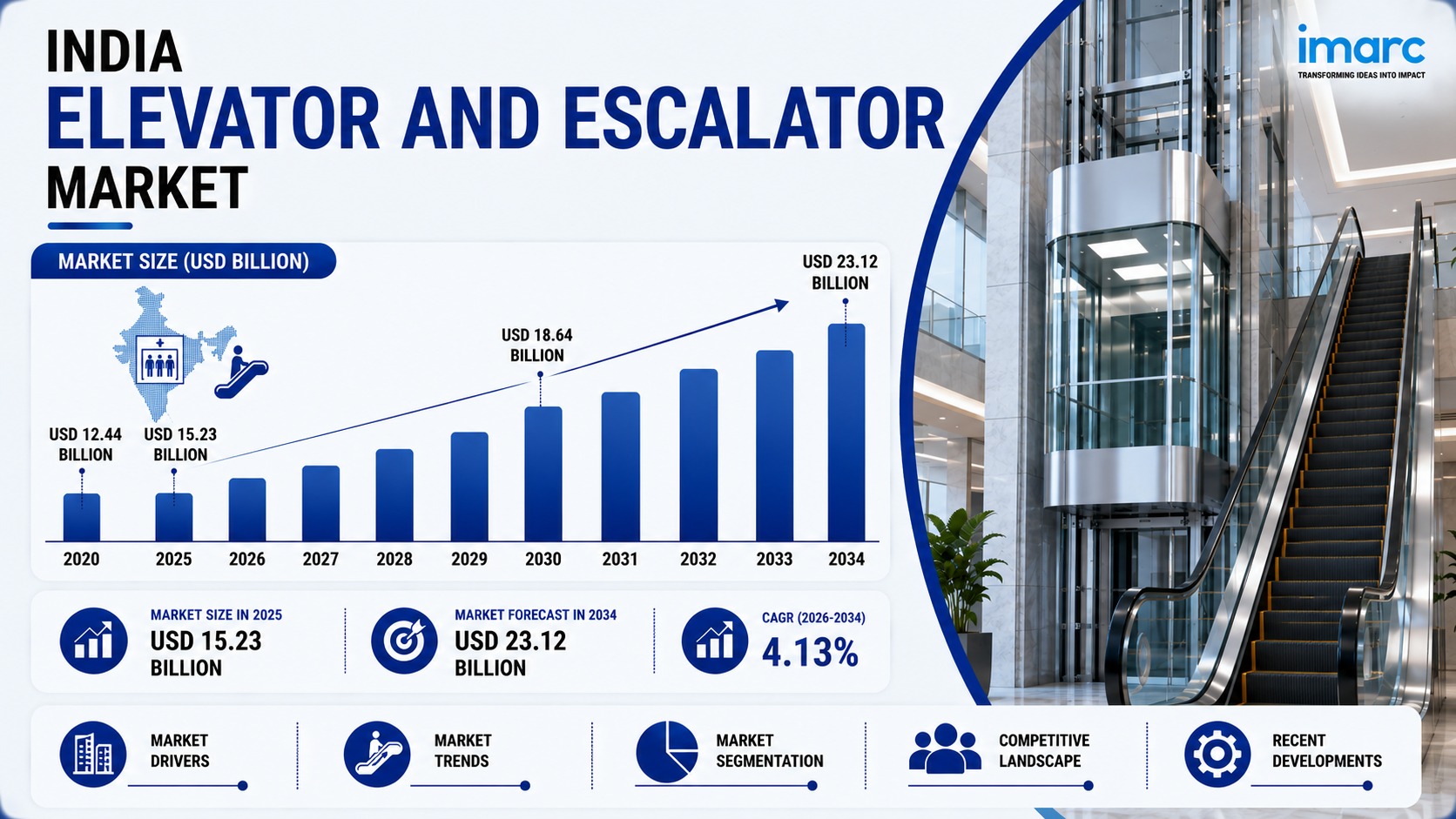
The India elevator and escalator industry size was valued at USD 15.23 Billion in 2025. Looking forward, the market is projected to reach USD 23.12 Billion by 2034, exhibiting a steady compound annual growth rate (CAGR) of 4.13% during 2026-2034. The industry is currently undergoing a structural expansion, intrinsically linked to India's rapid urban verticalization and massive transit infrastructure overhaul. As Tier-1 cities push skyscraper boundaries and Tier-2 cities embrace mid-rise developments, the demand for safe, highly efficient vertical mobility is accelerating. Simultaneously, the market is transitioning from purely mechanical hardware to smart, IoT-enabled ecosystems that prioritize energy conservation, predictive maintenance, and touchless user experiences.
Market Size & Forecast:
- Market Size (2025): USD 15.23 Billion
- Projected Market Size (2034): USD 23.12 Billion
- CAGR (2026 - 2034): 4.13%
- Leading Regional Market: West India (32.5% Share in 2025)
- Fastest Growing Region: South India (Driven by IT hubs and metro expansions)
Key Market Trends:
- Machine-Room-Less (MRL) Elevators as the Default:
Urban space constraints are driving a definitive shift towards MRL systems. By removing the need for a bulky overhead machine room, these elevators optimize rentable square footage for developers and reduce building heights, rapidly becoming the standard for mid- and high-rise commercial structures.
- Transition to Touchless and Hygienic Cabin Interfaces:
The market is rapidly moving past standard mechanical push-buttons. Premium commercial and healthcare buildings are increasingly deploying elevators equipped with holographic buttons, smartphone-integrated Bluetooth calling, and voice-activated destination dispatch systems to minimize surface contact and enhance hygiene.
- Integration of IoT for Predictive Maintenance:
OEMs are pivoting from reactive repairs to digital subscription models. By embedding IoT sensors across lift mechanics, companies continuously stream operational data to centralized cloud dashboards, predicting component failures (like door drive degradation) before they cause entrapments, thereby severely reducing unplanned downtime.
- Regenerative Drives for Green Building Compliance:
With the proliferation of LEED and IGBC-certified green real estate, developers are increasingly stipulating the inclusion of regenerative elevator drives. These advanced systems capture the kinetic energy generated during braking or descending and feed it back into the building's electrical grid, cutting overall lift energy consumption by up to 35%.
- Mandatory Modernization of Aging Urban Infrastructure:
State-level interventions, such as the Maharashtra Lift Act, are forcing building owners to overhaul decades-old elevator systems. This regulatory push is triggering a massive wave of controller upgrades, drive replacements, and structural safety audits, transforming modernization into a highly lucrative secondary revenue stream.
Request Sample Report (TOC & Charts): https://www.imarcgroup.com/india-elevator-escalator-market/requestsample
Strategic Market Dynamics:
Growth Drivers:
- Massive Vertical Expansion in the Mumbai Metropolitan Region (MMR):
The severe scarcity of horizontal land in Mumbai and Pune is forcing developers to build ultra-tall skyscrapers. With projections indicating a 34% surge in buildings exceeding 40 floors in the MMR, the requirement for high-speed, multi-car elevator systems acts as a colossal, hyper-concentrated volume driver for the region.
- Relentless Expansion of Urban Metro Rail Networks:
India's aggressive execution of transit infrastructure is fundamentally propelling the escalator and heavy-duty elevator segment. With the operational metro network crossing 1,000 km in 2025 and massive new phases launching in cities like Bengaluru, Chennai, and Hyderabad, bulk procurement of public-grade, continuous-duty mobility equipment is guaranteed.
- The Rise of Premium Senior Living and Healthcare Communities:
As India's geriatric population expands (projected to reach 194 million by 2031), specialized senior living projects and tertiary healthcare hubs are proliferating. These developments require highly customized vertical mobility solutions, including stretcher-compatible dimensions, extended door-hold times, and enhanced safety sensors, driving demand for high-margin, specialized units.
- Substantial Capital Infusion via the Smart Cities Mission:
The successful completion of the vast majority of projects under the government’s 1.64 lakh crore Smart Cities Mission has vastly upgraded Tier-2 urban centers. The resulting modernization of public transit hubs, municipal buildings, and commercial plazas guarantees continuous, decentralized demand outside traditional metropolitan areas.
- Surge in Tier-2 and Tier-3 City Mid-Rise Construction:
The democratization of real estate development into emerging cities like Lucknow, Jaipur, and Coimbatore is unlocking massive new addressable markets. As these cities expand upwards to accommodate growing middle-class populations, value-focused OEMs are capturing immense volume through cost-effective, standardized residential lifts.
Market Restraints:
- Component Import Dependence and Currency Exposure:
The Indian elevator industry remains heavily dependent on imported electronic components, advanced microprocessors, and precision drives. This reliance exposes domestic assemblers to global supply chain disruptions, logistics constraints, and currency fluctuations, which can suddenly inflate manufacturing costs and compress margins.
- Severe Shortage of Certified Installation Technicians:
As the sheer volume of new installations and maintenance contracts scales, the sector faces an acute shortage of formally trained, certified elevator technicians. This talent deficit affects the speed of project commissioning and the quality of aftermarket servicing, forcing OEMs to invest heavily in in-house training academies.
Explore the Full Report with Charts, Table of Contents, and List of Figures: https://www.imarcgroup.com/india-elevator-escalator-market
Competitive Landscape & Key Company Insights:
The India elevator and escalator market is a highly consolidated oligopoly dominated by major multinational corporations. These global giants control the premium and high-speed skyscraper segments, leveraging their massive R&D budgets to introduce IoT capabilities and destination dispatch technologies. However, robust domestic players strongly contest the mid-rise and affordable residential segments. Competition is fiercely fought on the basis of maintenance contract pricing, energy efficiency ratings, and the aesthetic customization of cabins.
Some of the key players shaping the domestic ecosystem include:
- KONE Corporation
- Otis Elevator Company (I) Ltd.
- Schindler Group
- Johnson Lifts
- Mitsubishi Elevator India Pvt. Ltd.
- Hitachi Lift India Pvt. Ltd.
Deep-Dive Segment Insights:
Type Insights:
- Elevators
- Escalators
Key Insight: Elevators absolutely dominate the market, commanding a 96.8% share in 2025. Their universal necessity across residential apartments, corporate offices, and hospitals makes them the undisputed core of the industry. Escalators (3.2%) remain a niche, specialized segment concentrated heavily in mass transit hubs, airports, and large-scale shopping malls.
Service Insights:
- New Installation
- Maintenance and Repair
- Modernization
Key Insight: New Installation is the leading revenue engine, holding a 58.5% share in 2025, directly mirroring India's booming real estate and infrastructure pipeline. Maintenance and Repair (28.4%) ensures stable, recurring revenue for OEMs, while Modernization (13.1%) is steadily growing as older buildings upgrade to meet modern safety codes.
Region Insights:
- West India
- North India
- South India
- East India
Key Insight: West India is the commanding regional market, holding a 32.5% share in 2025. This dominance is heavily anchored by dense vertical construction in Mumbai, Pune, Ahmedabad, and Surat. South India stands out as the fastest-growing region, aggressively propelled by ongoing metro rail expansions and massive IT park construction in Bengaluru and Chennai.
Recent News and Developments:
- Otis India Expands Smart Elevator Manufacturing (2025-2026): To capitalize on the surging demand for IoT-enabled mobility, Otis Elevator Company announced strategic capacity expansions at its Bengaluru manufacturing facility. The expansion focuses on increasing the localized production of its Gen2 elevators and accelerating the rollout of its Otis ONE IoT predictive maintenance platform across Indian commercial real estate.
- KONE India Launches Sustainable DX Class Lifts (Late 2025): KONE reinforced its commitment to green building standards by launching its advanced DX Class elevators in the Indian market. These models feature built-in digital connectivity, regenerative drives, and eco-efficient hoisting machinery, specifically targeting developers aiming for prestigious IGBC and LEED platinum certifications.
- Massive Escalator Deployments for Mumbai Metro Line 3 (2025-2026): As the highly anticipated underground Mumbai Metro Line 3 (Aqua Line) progressed toward full operational status, contractors executed the installation of hundreds of heavy-duty, continuous-operation escalators. Notably, the project features some of the tallest escalators ever installed in India at deep-level stations like Terminal 2, significantly boosting the escalator segment's volume.
- Johnson Lifts Dominates Public Infrastructure Contracts (2025-2026): Domestic powerhouse Johnson Lifts secured a series of massive government contracts for the supply of escalators and elevators across various expanding railway stations under the Amrit Bharat Station Scheme. This development firmly positions the company as a critical partner in the government's push to modernize national railway infrastructure for enhanced passenger accessibility.
Customization Note: If you require any specific information not covered within this report's scope, we will provide it as part of the customization.
Request Report Customization: https://www.imarcgroup.com/request?type=report&id=31328&flag=E
Frequently Asked Questions (FAQs):
Q1. What is the India elevator and escalator market size in 2025?
Ans. The India elevator and escalator market was valued at USD 15.23 Billion in 2025.
Q2. What is the projected growth rate of the India elevator and escalator market?
Ans. The market is projected to reach USD 23.12 Billion by 2034, exhibiting a steady CAGR of 4.13% during the 2026-2034 forecast period.
Q3. What are the key factors driving the market?
Ans. The market is aggressively driven by rapid urbanization, massive vertical real estate expansion (especially in the Mumbai Metropolitan Region), the execution of national metro rail networks, and the mandate for smart, energy-efficient building infrastructure.
Q4. Which segment dominates the India elevator and escalator market?
Ans. Elevators overwhelmingly dominate the market, holding a 96.8% share in 2025, as they are a universal requirement for all multi-story residential and commercial buildings. New installations represent the largest service segment.
Q5. Which region holds the largest share in the market?
Ans. West India commands the largest market share at 32.5% in 2025, heavily sustained by intense high-rise construction activity in major economic hubs like Mumbai and Pune.
