
Flame Detector Market Size, Share, Growth, Analysis Forecast to 2030Market ResearchUpdated on Aug 8, 2024 View more like this | Visit India, UN | Contact GVR |
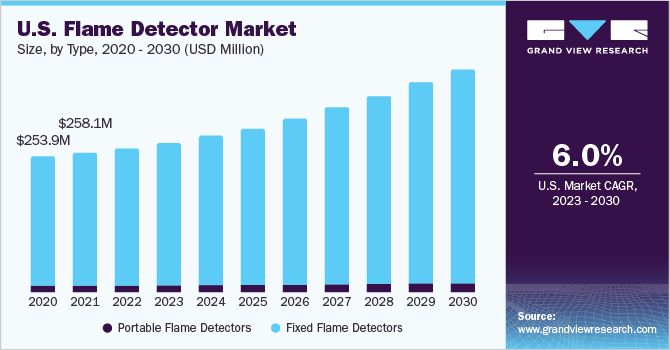
Flame Detector Industry Overview
The global flame detector market size was estimated at USD 927.8 million in 2022 and is expected to grow at a compound annual growth rate (CAGR) of 7.3% from 2023 to 2030. A flame detector uses sensors to detect and respond to the presence of a flame. These detectors are used to identify smoke and smokeless liquid that can initiate open fire. The rising adoption of flame detectors in industries, such as oil & gas, manufacturing, processing, transportation, and mining, owing to the growing emphasis on workplace safety and stringent government regulations related to fire safety is driving the market growth. Inaddition, the rising integration of the Internet of Things (IoT), big data, and advancements in flame-sensing technology are some of the major trends in the market.
The increasing demand for smart or intelligent fixed and portable flame detectors to deliver fast response times & high accuracy and the ability to detect flames in less time is propelling the growth of the market. For instance, in July 2021, the Korea Research Institute of Standards and Science (KRISS) and HansunST, a KRISS-affiliated company, unveiled an intelligent fire detection system capable of detecting a fire within 10 seconds of its start. The system distinguishes between actual fires and fires used by humans. This intelligent detector has a remarkable ability to accurately sense even a small flame as tiny as 3 centimeters in size in the latent phase, promptly activating an alarm or sending an alert message via a smartphone application. Flame detectors can also detect fire according to the air movement and air temperature.
Gather more insights about the market drivers, restrains and growth of the Flame Detector Market
The flame detectors use Infrared (IR) or Ultraviolet (UV) technology to detect flames in less than a second. The flame detector responds to the detection of a flame according to its installation. For instance, these detectors can deactivate the fuel line, sound an alarm, or activate a fire suppression system. Thus, these features and benefits of flame detectors will help boost the market growth. Increasing demand for advanced technology-based flame detectors is further boosting the market’s growth. Two common and most popular optical flame detectors are a multi-spectrum infrared (MSIR) flame detector and a combination ultraviolet/infrared (UV/IR) flame detector. Unlike simple IR or UV detectors, MSIR and UV/IR flame detectors are sensitive to over one band on the energy spectrum and thus are less prone to produce a false alarm.
Both technologies perform effectively in indoor as well as outdoor environments and deliver a reasonably fast response time. Factors, such as high installation and maintenance costs, are some drawbacks of flame detection technologies that are expected to restrain the growth of the market. For instance, IR flame detectors are susceptible to producing false alarms under certain conditions of motion, heat, and gas emissions. The UV flame detectors are not ideal for environments that are dusty or contain airborne oil droplets. In addition, UV/IR flame detectors have certain limitations. They are not suitable for detecting fires that do not involve carbon combustion, and they only identify fires that emit both UV and IR radiation simultaneously rather than independently.
Browse through Grand View Research's Sensors & Controls Industry Research Reports.
- The UV LED market size was estimated at USD 1.36 billion in 2023 and is anticipated to grow at a CAGR of 24.6% from 2024 to 2030.
- The global vehicles intelligence battery sensor market size was estimated at USD 2.96 billion in 2023 and is expected to grow a CAGR of 12.8% from 2024 to 2030.
Key Companies & Market Share Insights
The market players are continuously working towardnew product development and up-gradation of their existing product portfolio. For instance, in June 2023, Teledyne Gas and Flame Detection introduced the Spyglass SG50-F line of flame detectors to enhance the protection of individuals and valuable assets, simplifying safety measures. Spyglass SG50-F flame detectors work by analyzing the radiation absorption resulting from gases in the atmosphere and relating it to background atmospheric absorption. These detectors feature UV-IR and triple infrared (IR3) options for a range of applications. The IR3 version is specifically developed to detect hydrocarbons for applications, such as oil & gas platforms, refineries, petrochemical plants, floating production storage & offloading systems, marine facilities, turbine enclosures, and compressor stations.
In addition, in August 2022, Honeywell International Inc. announced the release of the Morley MAx fire detection and alarm system to improve the safety of buildings and residents. The system is equipped with an innovative 7-inch touchscreen panel, delivering an ergonomic and highly intuitive user interface. The Morley MAx is designed for operation in various industries, such as healthcare, education, residential, commercial, and hospitality. Some of the prominent players in the global flame detector market include:
- Honeywell International Inc.
- Drägerwerk AG & Co. KGaA
- Siemens
- REZONTECH CO., LTD.
- Teledyne Gas and Flame Detection
- MSA Safety Incorporated
- Det-Tronics
- Johnson Controls
- Emerson Electric Co.
- Spectrex.
Order a free sample PDF of the Flame Detector Market Study, published by Grand View Research.
