
TEC Modules (Thermoelectric Cooler Modules)ElectronicsUpdated on Dec 7, 2017 View more like this | Visit CALIFORNIA, PA | Contact ATI |
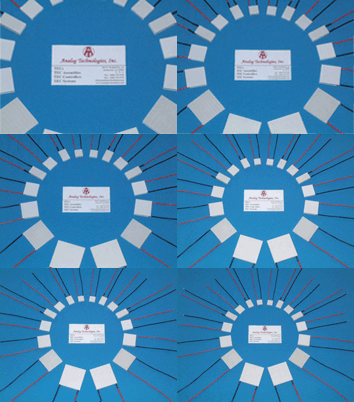
This is a magic little tile,but it has a big role.
WE ARE THE WORLD'S LEADING TEC MODULE SUPPLIER: MOST COMPLETE SERIES AND LARGEST STOCKING INVERNTORY.
TEC (Thermoelectric coolers) is a peltier module, and can also be called peltier cooler, thermoelectric module, and thermoelectric cooler, etc..
Thermoelectric coolers can generate both heating or cooling thermal power when applying an electric DC current at different directions. When the current flows in one direction, one of the peltier cooler's plates is heated up while the other is cooled down. As the current reverses the direction, the TEC plates will reverse their thermal polarity accordingly. TEC modules have many applications. One of them is to keep diode laser chips working at a constant temperature, thus, the lasers will output a laser beam with a stable wavelength, constant power, and low optical noise.
ATI has developed a new kind of thermal cycling TEC modules.
When designing a TEC based temperature regulation system, choosing the right TEC is crital. These are the general suggestions:
1. TECs have limited life time. Their health strength can be measured by the change of their AC resistance. When a TEC gets "old" or worn out, the AC resistance (ACR) will increase. To build a reliable system, only good "healthy" TECs should be used. Measuring the initial ACR is critical; make sure that the initial ACRs are within the specification. The ACR must be measured by special meters. We carry such a meter, link here.
2. Try your best to minimize the thermal resistance between the TEC module plates and the thermal heat-sink on the hot side and the thermal load on the cold side.
3. The best way to connect the TEC modules plates to the heat-sink or the thermal load is by metalizing the TEC modules plates and soldering the metalized surface directly onto the heat-sink surface and/or the thermal load surface.
4. Try your best to design the system with smaller maximum temperature difference between the 2 plates (hot side and the cold side) of the TEC modules, so that the thermal efficiency of the system will be high. It would be the best not to require the maximum temperature difference be > 30°C.
5. When the required maximum temperature difference is small, such as < 30°C, use large TEC modules to drive small thermal load which will result in high thermal efficiency.
6. The thermal efficiency of the TEC modules is usually measured by COP: Coefficient of Performance. It is defined as the ratio: (Thermal output power)/(Electrical input power). A well designed system can achieve a COP to be > 2.
We offer a wide variety of high quality TEC Modules at low prices, including square shape and circular shape TECs, single stage and multi-stage TECs. Many of them work well with our TEC Controllers, Thermistors and Thermally Conductive Epoxy.
http://www.analogtechnologies.com/tec-module.html
WE ARE THE WORLD'S LEADING TEC MODULE SUPPLIER: MOST COMPLETE SERIES AND LARGEST STOCKING INVERNTORY.
TEC (Thermoelectric coolers) is a peltier module, and can also be called peltier cooler, thermoelectric module, and thermoelectric cooler, etc..
Thermoelectric coolers can generate both heating or cooling thermal power when applying an electric DC current at different directions. When the current flows in one direction, one of the peltier cooler's plates is heated up while the other is cooled down. As the current reverses the direction, the TEC plates will reverse their thermal polarity accordingly. TEC modules have many applications. One of them is to keep diode laser chips working at a constant temperature, thus, the lasers will output a laser beam with a stable wavelength, constant power, and low optical noise.
ATI has developed a new kind of thermal cycling TEC modules.
When designing a TEC based temperature regulation system, choosing the right TEC is crital. These are the general suggestions:
1. TECs have limited life time. Their health strength can be measured by the change of their AC resistance. When a TEC gets "old" or worn out, the AC resistance (ACR) will increase. To build a reliable system, only good "healthy" TECs should be used. Measuring the initial ACR is critical; make sure that the initial ACRs are within the specification. The ACR must be measured by special meters. We carry such a meter, link here.
2. Try your best to minimize the thermal resistance between the TEC module plates and the thermal heat-sink on the hot side and the thermal load on the cold side.
3. The best way to connect the TEC modules plates to the heat-sink or the thermal load is by metalizing the TEC modules plates and soldering the metalized surface directly onto the heat-sink surface and/or the thermal load surface.
4. Try your best to design the system with smaller maximum temperature difference between the 2 plates (hot side and the cold side) of the TEC modules, so that the thermal efficiency of the system will be high. It would be the best not to require the maximum temperature difference be > 30°C.
5. When the required maximum temperature difference is small, such as < 30°C, use large TEC modules to drive small thermal load which will result in high thermal efficiency.
6. The thermal efficiency of the TEC modules is usually measured by COP: Coefficient of Performance. It is defined as the ratio: (Thermal output power)/(Electrical input power). A well designed system can achieve a COP to be > 2.
We offer a wide variety of high quality TEC Modules at low prices, including square shape and circular shape TECs, single stage and multi-stage TECs. Many of them work well with our TEC Controllers, Thermistors and Thermally Conductive Epoxy.
http://www.analogtechnologies.com/tec-module.html
