
HVAC Control Market Size, Share, Growth, Challenges, & Global Forecast 2024-2032Building Construction Control ServicesUpdated on Nov 22, 2024 View more like this | Visit BROOKLYN, NY | Contact IMARC Group |
HVAC Control Industry:
Summary:
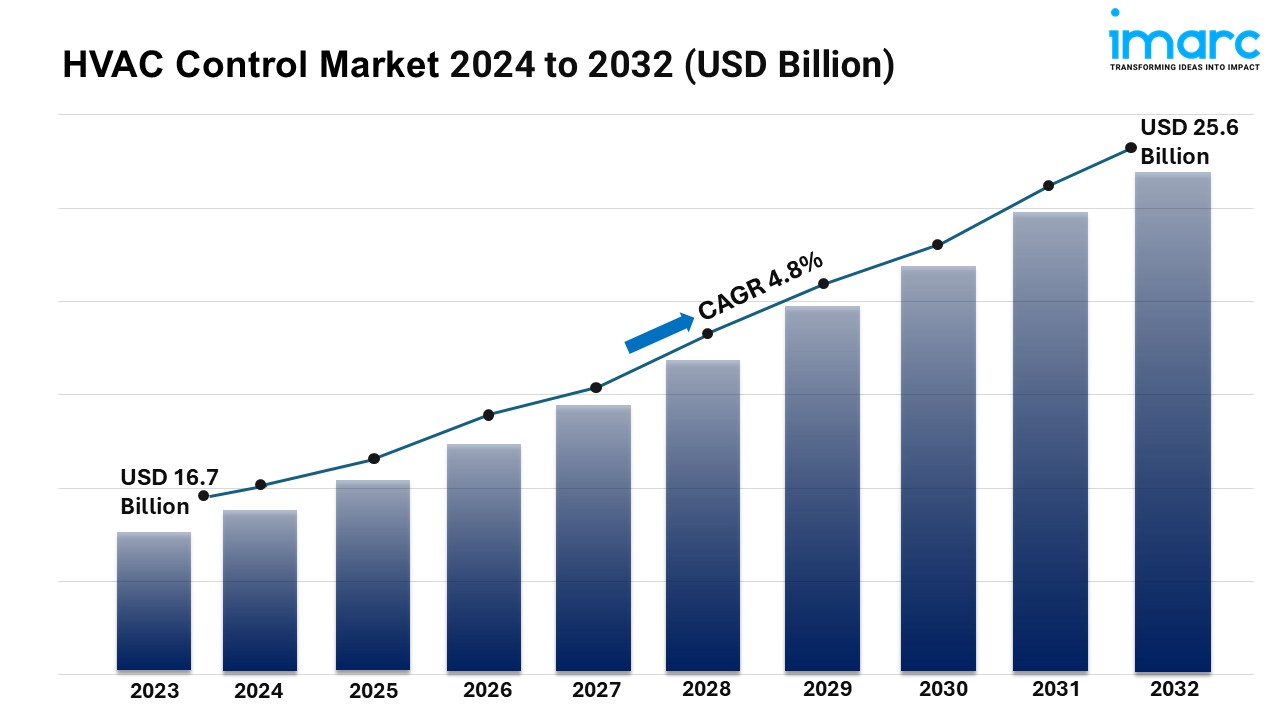
- The global HVAC control market size reached USD 16.7 Billion in 2023.
- The market is expected to reach USD 25.6 Billion by 2032, exhibiting a growth rate (CAGR) of 4.8% during 2024-2032.
- By component, sensors represented the largest segment due to their widespread adoption for accurate monitoring and advanced HVAC system integration.
- By implementation type, new construction represented the largest segment due to government initiatives promoting eco-friendly buildings and the expansion of smart city projects.
- By system, temperature control systems represented the largest segment as they are fundamental for precise climate regulation and compliance with energy regulations.
- Based on the end user, the market has been segmented into residential, commercial, and industrial.
- By region, Asia Pacific represented the largest segment due to the robust expansion of the construction sector and increasing investments in smart home technologies.
- The HVAC control market is seeing a rise due to the integration of advanced technologies like AI and IoT, which enhance energy efficiency and user convenience.
- Urbanization and the shift towards sustainable building practices are propelling the adoption of advanced HVAC controls in new and retrofitted infrastructure.
Request to Get the Sample Report: https://www.imarcgroup.com/hvac-control-market/requestsample
Industry Trends and Drivers:
Rising demand for energy efficiency
The increasing need for energy-efficient solutions is significantly driving the HVAC control market share. Governments and organizations are promoting sustainability by implementing stringent energy regulations. HVAC control systems are essential in optimizing energy consumption, reducing greenhouse gas emissions, and ensuring cost savings for building owners. Advanced technologies such as smart thermostats and automated control systems help maintain optimal temperatures while minimizing energy usage. These smart controls integrate with IoT and AI to allow for real-time monitoring and automated adjustments. As a result, their adoption is expanding rapidly in commercial, industrial, and residential sectors, contributing to the strong growth trajectory of the HVAC control industry worldwide.
Technological advancements and smart homes
The growing trend of smart homes and automation is playing a pivotal role in propelling the HVAC control market size. Consumers are increasingly interested in integrating their HVAC systems with other smart home devices, fostering a seamless and energy-efficient living experience. Technologies such as AI-driven algorithms and machine learning enable HVAC control systems to predict user behavior and adjust settings accordingly. Moreover, advancements, such as wireless connectivity, voice activation, and mobile app integration have made HVAC systems more user-friendly and accessible. This technological leap is ensuring that homeowners and businesses can manage their energy consumption more effectively, enhancing comfort and convenience while driving demand for modern HVAC solutions.
Urbanization and infrastructure development
The rapid pace of urbanization and infrastructure development is significantly influencing HVAC control market trends. As more cities are built and expanded globally, the need for sophisticated HVAC systems to ensure thermal comfort and air quality in large buildings and complexes is growing. New constructions, particularly in emerging economies, are focusing on sustainable solutions to comply with environmental regulations and enhance energy efficiency. Modern HVAC control systems equipped with intelligent sensors and zoning capabilities are ideal for managing the temperature and air distribution in large-scale structures. This trend is supporting a rise in the market as new and retrofit projects increasingly incorporate advanced HVAC control technologies.
View Full Report with TOC & List of Figure: https://www.imarcgroup.com/hvac-control-market
HVAC Control Market Report Segmentation:
Breakup By Component:
- Sensors
- Controllers and Controlled Devices
By component, sensors represented the largest segment due to their critical role in real-time data collection and enhancing system automation for optimal HVAC performance.
Breakup By Implementation Type:
- New Construction
- Retrofit
By implementation type, new construction represented the largest segment driven by increasing investments in smart infrastructure and energy-efficient building standards.
Breakup By System:
- Temperature Control Systems
- Ventilation Control Systems
- Humidity Control Systems
- Integrated Control Systems
By system, temperature control systems represented the largest segment as they are essential for maintaining thermal comfort and energy savings in both residential and commercial spaces.
Breakup By End User:
- Residential
- Commercial
- Industrial
Based on the end user, the market has been segmented into residential, commercial, and industrial.
Breakup By Region:
- North America (United States, Canada)
- Europe (Germany, France, United Kingdom, Italy, Spain, Others)
- Asia Pacific (China, Japan, India, Australia, Indonesia, Korea, Others)
- Latin America (Brazil, Mexico, Others)
- Middle East and Africa (United Arab Emirates, Saudi Arabia, Qatar, Iraq, Other)
By region, Asia Pacific represented the largest segment due to rapid urbanization, significant population growth, and an increasing need for advanced climate control solutions. This demand is further propelled by large-scale infrastructure projects and the adoption of smart technologies, driving the expansion of HVAC control systems across residential, commercial, and industrial sectors.
Top HVAC Control Market Leaders: The HVAC control market research report outlines a detailed analysis of the competitive landscape, offering in-depth profiles of major companies. Some of the key players in the market are:
- Azbil Corporation
- Carrier Global Corporation
- Computrols Inc.
- Daikin Industries Ltd
- Danfoss
- Delta Electronics Inc.
- Emerson Electric Co.
- Honeywell International Inc.
- Johnson Controls International
- KMC Controls
- Schneider Electric SE
- Siemens AG
Key highlights of the report:
- Market Performance (2018-2023)
- Market Outlook (2024-2032)
- Porter’s Five Forces Analysis
- Market Drivers and Success Factors
- SWOT Analysis
- Value Chain
- Comprehensive Mapping of the Competitive Landscape
About Us:
As a global frontrunner in the field of market research, IMARC Group offers invaluable management strategies and in-depth market intelligence. Our collaborative efforts span multiple industries and geographical regions, where we assist clients in exploring substantial opportunities, overcoming critical challenges, and fostering transformative business processes.
Our information products are tailored to meet the needs of business leaders across various high-tech industries, including pharmaceuticals, biotechnology, and advanced materials. We provide comprehensive market forecasts and industry analyses, focusing on sectors such as biotechnology, advanced materials, pharmaceuticals, food and beverage, as well as innovative fields like nanotechnology and novel processing methods, ensuring our clients are well-prepared to lead in their respective fields.
Contact US:
IMARC Group
134 N 4th St. Brooklyn, NY 11249, USA
Email: [email protected]
Tel No:(D) +91 120 433 0800
United States: +1-631-791-1145
