
Australia Seafood Market | Analysis Report 2026-2034Fish & Seafood WholesaleUpdated on Jul 30, 2026 View more like this | Visit Australia, UN | Contact IMARC Group |
Market Overview
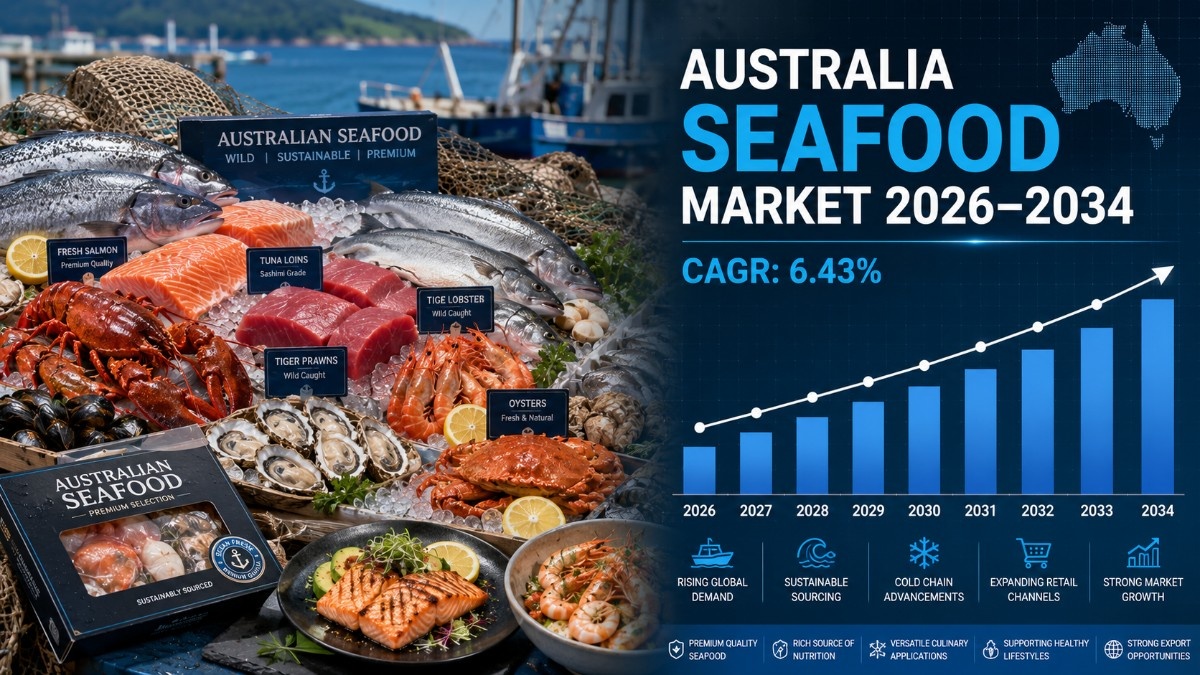
The Australia seafood market size reached USD 3.22 Billion in 2025 and is projected to reach USD 5.73 Billion by 2034, growing at a compound annual growth rate (CAGR) of 6.43% from 2026 to 2034. Rising health consciousness, expanding aquaculture infrastructure, and growing export demand are the primary growth forces shaping this market. The market is strategically important to Australia's food and agriculture sector as it enables the nation to meet domestic protein demand, generate export revenue, and support regional employment through sustainable fishing and aquaculture operations.
Australia Seafood Market Summary
• The Australia seafood market encompasses a range of products, including fish, shrimp, and other species, available in fresh/chilled, frozen, processed, and canned forms, distributed through retail and food service channels to meet domestic consumer needs and international export demand.
• These products are valued for their role in providing healthy protein, supporting sustainable diets, contributing to economic growth, and maintaining Australia's reputation for high-quality seafood in international markets.
• The ecosystem includes wild-catch fishers, aquaculture operators (JBS Foods, Seafarms Group), processors, cold-chain logistics providers, retailers, food service operators, exporters, regulatory bodies (DAFF, FSANZ), and consumers.
• Major segments identified in the market include type (fish, shrimp, others), form (canned, fresh/chilled, frozen, processed), distribution channel (off-trade: convenience stores, online channel, supermarkets and hypermarkets, others; on-trade), and region (Australian Capital Territory & New South Wales, Victoria & Tasmania, Queensland, Northern Territory & Southern Australia, Western Australia).
• The market is benefiting from rising consumer demand for healthy protein, expanding aquaculture infrastructure, growing export demand and trade agreements, and e-commerce and cold-chain advancement.
• Fish leads the type segmentation at 58.7% in 2025, driven by widespread consumer preference for salmon, tuna, and barramundi. Fresh/Chilled commands 36.8% form share. ACT & New South Wales dominates the regional landscape with a 34.5% share.
PORTER'S FIVE FORCES ANALYSIS AUSTRALIA SEAFOOD MARKET
Bargaining Power of Suppliers Moderate
• The seafood supply chain includes wild-catch fishers, aquaculture operators, processors, and cold-chain logistics providers.
• Large aquaculture operators (JBS Foods) and premium wild-catch suppliers have moderate bargaining power due to scale and quality.
• However, the presence of multiple suppliers and the ability of processors to source from different fisheries moderates individual supplier power.
• Climate change and quota restrictions reduce supply predictability, increasing the relative power of suppliers with reliable, certified production.
Bargaining Power of Buyers High
• Buyers in the Australian seafood market, including retail supermarkets, food service operators, and export customers, have high bargaining power.
• Large retailers can negotiate pricing, quality specifications, and delivery terms based on volume.
• The availability of imported seafood provides buyers with alternatives to domestic supply.
• However, premium, sustainably certified species and fresh/chilled products have less buyer power due to limited supply and consumer willingness to pay premiums.
Threat of New Entrants Moderate
• The market is influenced by established aquaculture operators, processors, and export-focused businesses with strong supply chains and certifications.
• Capital requirements for aquaculture infrastructure, processing facilities, and cold-chain logistics favor established players.
• However, government support for aquaculture development and the growing demand for premium seafood are lowering barriers for new entrants.
• Niche players focusing on value-added products, direct-to-consumer channels, or specific species can enter the market with targeted strategies.
Threat of Substitutes Moderate
• Seafood faces substitution from alternative proteins including chicken, beef, pork, and plant-based proteins.
• However, the unique nutritional profile of seafood (omega-3, lean protein) and its premium positioning support its unique position.
• Rising health consciousness and the perception of seafood as a healthy, sustainable protein reduce the attractiveness of substitutes.
• Imported seafood provides a complementary rather than substitutable source for some species.
Competitive Rivalry High
• The market features a competitive landscape of integrated aquaculture companies, wild-catch operators, and export-focused businesses competing on quality, certification, brand, and price.
• Differentiation occurs through species specialization, sustainability credentials, value-added processing, and brand equity.
• Competition is intensifying as operators invest in aquaculture expansion, premium product development, and export market diversification.
• Innovation in RAS technology, traceability, and value-added products drives competitive dynamics.
MARKET GROWTH DRIVERS
Rising Consumer Demand for Healthy Protein
Rising awareness of omega-3 fatty acids, lean protein benefits, and heart health advantages is driving per-capita seafood consumption higher. Health-conscious Australians increasingly substitute red meat with fish and shrimp, directly boosting retail and food service demand across all age demographics. This health-driven shift has structurally elevated seafood demand post-pandemic, with nutritional positioning and clean-label messaging influencing purchasing decisions across retail and food service channels throughout Australia.
Expanding Aquaculture Infrastructure
Government investment in land-based recirculating aquaculture systems (RAS), offshore cage aquaculture, and selective breeding programs is expanding domestic supply capacity. Salmon farming in Tasmania and barramundi aquaculture in Queensland is scaling rapidly to meet growing consumer and export demand. ASC, MSC, and BAP certification uptake is accelerating among Australian aquaculture and wild-catch operators, providing export market access premiums and meeting retailer sustainability requirements.
Growing Export Demand & Trade Agreements
Free trade agreements with Japan, South Korea, China, and ASEAN nations are lowering tariff barriers for Australian seafood exports. Premium lobster, abalone, southern bluefin tuna, and rock lobster command strong prices in Asian markets, driving investment in processing and export-grade cold-chain infrastructure. Growing Asian middle-class demand for premium Australian seafood presents significant revenue opportunities, with direct online export channels enabling producers to capture higher-value consumer segments.
AUSTRALIA SEAFOOD MARKET SEGMENTATION
Type Insights:
• Fish
• Shrimp
• Others
Form Insights:
• Canned
• Fresh/Chilled
• Frozen
• Processed
Distribution Channel Insights:
• Off-Trade: Convenience Stores, Online Channel, Supermarkets and Hypermarkets, Others
• On-Trade
Regional Insights:
• Australia Capital Territory & New South Wales
• Victoria & Tasmania
• Queensland
• Northern Territory & Southern Australia
• Western Australia
COMPETITIVE LANDSCAPE
The Australia seafood market is moderately fragmented, with integrated aquaculture and processing companies, wild-catch specialist operators, and export-focused seafood businesses competing across domestic and international channels. Leading players leverage sustainability certification, cold-chain capabilities, and brand equity to maintain competitive advantage. Market dynamics are characterized by aquaculture expansion, premiumisation, and digital channel growth.
Key players mentioned in the report context include:
• JBS Foods, operating through Huon Aquaculture, is an integrated seafood company with a fully managed supply chain spanning aquaculture operations, value-added processing, and retail and export channels. The company is focused on expanding production capacity, advancing sustainable farming practices, and enhancing its value-added product portfolio to meet growing consumer demand for premium Tasmanian salmon products.
• Walker Seafoods Australia is a leading tuna operator specialising in the Eastern Tuna and Billfish Fishery. In August 2024, Walker Seafoods announced a partnership with renowned chef Neil Perry to launch a new line of preserved local tuna for sale in Australian supermarkets, supporting sustainable seafood awareness. The company is focused on building premium domestic retail brand presence through chef collaborations and value-added product innovation.
• Seafarms Group is an emerging player focused on scaling large-scale tropical prawn aquaculture for domestic and Asian export market penetration, leveraging Australia's tropical aquaculture potential.
REGIONAL ANALYSIS
ACT & New South Wales: ACT & New South Wales dominate the Australia seafood market with a 34.5% share in 2025, driven by Sydney's position as the country's largest seafood trading hub, its dense urban consumer base, and its concentration of premium restaurant and institutional food service operators. The region benefits from superior cold-chain distribution infrastructure serving both retail and institutional customers, with Sydney Fish Market acting as a key trading and distribution centre. Rising health consciousness and premium seafood demand in NSW drive market growth.
Queensland: Queensland holds 22.1% market share in 2025, anchored by prawn aquaculture, barramundi farming, and reef species harvesting. The state's tropical aquaculture operations support significant domestic retail and Asian export sales. Queensland's expanding aquaculture infrastructure and government investment are driving production capacity growth. The state's warm climate and growing population create strong domestic demand for seafood.
Victoria & Tasmania: Victoria & Tasmania account for 18.3% of the market in 2025, reflecting dominance in salmon and oyster aquaculture, southern bluefin tuna processing, and significant urban food service demand from Melbourne. Tasmania's cold, clean waters support premium salmon farming, while Victoria's large urban population drives retail and food service demand. Aquaculture innovation and export market access are supporting growth in this region.
Western Australia: Western Australia represents 14.2% of the market in 2025, leading in premium export species including rock lobster and pearl oyster, commanding strong values in Asian export markets. The state's significant wild-capture fisheries support both domestic and export demand. Growing Asian middle-class demand for premium Australian seafood presents significant revenue opportunities for WA producers.
NT & Southern Australia: The Northern Territory and South Australia account for 10.9% of the market, with barramundi aquaculture expansion, oyster production, and developing aquaculture investment in key coastal growing regions. The region's tropical aquaculture potential and government support for sustainable development are driving growth. Direct-to-consumer and export channels are emerging as significant market opportunities.
RECENT INDUSTRY DEVELOPMENTS
July 2026: Australia introduced mandatory Country of Origin Labelling (CoOL) for seafood served by hospitality businesses from 1 July 2026. Restaurants, cafs, pubs, clubs, takeaways, and food trucks must now identify seafood as Australian (A), Imported (I), or Mixed (M). Around 64% of seafood consumed in Australia is imported, and the new rules are designed to improve transparency and support domestic seafood producers.
July 2026: The Australian seafood industry gathered at Seafood Directions 2026, held in Sydney from 2830 July, bringing together seafood producers, processors, exporters, retailers, and policymakers. The conference focused on sustainable fisheries, aquaculture innovation, export opportunities, and digital transformation, reinforcing the industry's commitment to long-term growth.
June 2026: Safcol opened a new AUD 11 million fish market in Thebarton, South Australia, featuring upgraded digital traceability systems, modern refrigeration, and new auction facilities. The investment complements Safcol's broader AUD 80 million food manufacturing expansion and strengthens seafood distribution for wholesalers, retailers, and restaurants across Australia.
January 2026: The new Sydney Fish Market officially opened at Glebe, replacing the historic Blackwattle Bay site after a redevelopment valued at approximately AUD 836 million. The new market includes 35,000 square metres of facilities, making it one of the world's largest seafood markets and significantly enhancing Australia's seafood trading and tourism infrastructure.
January 2026: Australia's seafood market maintained strong growth momentum, reaching USD 3.22 billion in 2025 and projected to expand to USD 5.73 billion by 2034, at a CAGR of 6.43% (20262034). Growth is supported by rising seafood consumption, expanding aquaculture production, increasing export demand, and growing consumer preference for high-protein, sustainably sourced seafood.
Note: If you need any specific information that is not covered currently within the scope of the report, we will provide the same as a part of customization.
Report Format, Delivery, and Customization Details
• Report Format Mode: PDF and Excel (Editable version in PPT/Word format available on special request)
• Report Delivery Mode: Online Delivery, Physical Delivery
• Report Delivery Time: Report Delivered Over Email within 24 to 48 hours. If requested by the client, a physical copy will be delivered within three to ten days.
• Report Confirmation Mode: Yes via Email
• Report Customization Mode: Yes via Email / Call
• Report Table of Content: Yes
• Report List of Figures: Yes
• Report Methodology Mode: Yes
• Request For Sample Report: Yes
About Us
IMARC Group is a global management consulting firm that helps the world's most ambitious changemakers to create a lasting impact. The company provides a comprehensive suite of market entry and expansion services. IMARC offerings include thorough market assessment, feasibility studies, company incorporation assistance, factory setup support, regulatory approvals and licensing navigation, branding, marketing and sales strategies, competitive landscape and benchmarking analyses, pricing and cost research, and procurement research.
Contact Us
IMARC Group
134 N 4th St., Brooklyn, NY 11249, USA
Email: [email protected]
Tel No: (D) +91 120 433 0800
United States: +1-201-971-6302
The Australia seafood market size reached USD 3.22 Billion in 2025 and is projected to reach USD 5.73 Billion by 2034, growing at a compound annual growth rate (CAGR) of 6.43% from 2026 to 2034. Rising health consciousness, expanding aquaculture infrastructure, and growing export demand are the primary growth forces shaping this market. The market is strategically important to Australia's food and agriculture sector as it enables the nation to meet domestic protein demand, generate export revenue, and support regional employment through sustainable fishing and aquaculture operations.
Australia Seafood Market Summary
• The Australia seafood market encompasses a range of products, including fish, shrimp, and other species, available in fresh/chilled, frozen, processed, and canned forms, distributed through retail and food service channels to meet domestic consumer needs and international export demand.
• These products are valued for their role in providing healthy protein, supporting sustainable diets, contributing to economic growth, and maintaining Australia's reputation for high-quality seafood in international markets.
• The ecosystem includes wild-catch fishers, aquaculture operators (JBS Foods, Seafarms Group), processors, cold-chain logistics providers, retailers, food service operators, exporters, regulatory bodies (DAFF, FSANZ), and consumers.
• Major segments identified in the market include type (fish, shrimp, others), form (canned, fresh/chilled, frozen, processed), distribution channel (off-trade: convenience stores, online channel, supermarkets and hypermarkets, others; on-trade), and region (Australian Capital Territory & New South Wales, Victoria & Tasmania, Queensland, Northern Territory & Southern Australia, Western Australia).
• The market is benefiting from rising consumer demand for healthy protein, expanding aquaculture infrastructure, growing export demand and trade agreements, and e-commerce and cold-chain advancement.
• Fish leads the type segmentation at 58.7% in 2025, driven by widespread consumer preference for salmon, tuna, and barramundi. Fresh/Chilled commands 36.8% form share. ACT & New South Wales dominates the regional landscape with a 34.5% share.
PORTER'S FIVE FORCES ANALYSIS AUSTRALIA SEAFOOD MARKET
Bargaining Power of Suppliers Moderate
• The seafood supply chain includes wild-catch fishers, aquaculture operators, processors, and cold-chain logistics providers.
• Large aquaculture operators (JBS Foods) and premium wild-catch suppliers have moderate bargaining power due to scale and quality.
• However, the presence of multiple suppliers and the ability of processors to source from different fisheries moderates individual supplier power.
• Climate change and quota restrictions reduce supply predictability, increasing the relative power of suppliers with reliable, certified production.
Bargaining Power of Buyers High
• Buyers in the Australian seafood market, including retail supermarkets, food service operators, and export customers, have high bargaining power.
• Large retailers can negotiate pricing, quality specifications, and delivery terms based on volume.
• The availability of imported seafood provides buyers with alternatives to domestic supply.
• However, premium, sustainably certified species and fresh/chilled products have less buyer power due to limited supply and consumer willingness to pay premiums.
Threat of New Entrants Moderate
• The market is influenced by established aquaculture operators, processors, and export-focused businesses with strong supply chains and certifications.
• Capital requirements for aquaculture infrastructure, processing facilities, and cold-chain logistics favor established players.
• However, government support for aquaculture development and the growing demand for premium seafood are lowering barriers for new entrants.
• Niche players focusing on value-added products, direct-to-consumer channels, or specific species can enter the market with targeted strategies.
Threat of Substitutes Moderate
• Seafood faces substitution from alternative proteins including chicken, beef, pork, and plant-based proteins.
• However, the unique nutritional profile of seafood (omega-3, lean protein) and its premium positioning support its unique position.
• Rising health consciousness and the perception of seafood as a healthy, sustainable protein reduce the attractiveness of substitutes.
• Imported seafood provides a complementary rather than substitutable source for some species.
Competitive Rivalry High
• The market features a competitive landscape of integrated aquaculture companies, wild-catch operators, and export-focused businesses competing on quality, certification, brand, and price.
• Differentiation occurs through species specialization, sustainability credentials, value-added processing, and brand equity.
• Competition is intensifying as operators invest in aquaculture expansion, premium product development, and export market diversification.
• Innovation in RAS technology, traceability, and value-added products drives competitive dynamics.
MARKET GROWTH DRIVERS
Rising Consumer Demand for Healthy Protein
Rising awareness of omega-3 fatty acids, lean protein benefits, and heart health advantages is driving per-capita seafood consumption higher. Health-conscious Australians increasingly substitute red meat with fish and shrimp, directly boosting retail and food service demand across all age demographics. This health-driven shift has structurally elevated seafood demand post-pandemic, with nutritional positioning and clean-label messaging influencing purchasing decisions across retail and food service channels throughout Australia.
Expanding Aquaculture Infrastructure
Government investment in land-based recirculating aquaculture systems (RAS), offshore cage aquaculture, and selective breeding programs is expanding domestic supply capacity. Salmon farming in Tasmania and barramundi aquaculture in Queensland is scaling rapidly to meet growing consumer and export demand. ASC, MSC, and BAP certification uptake is accelerating among Australian aquaculture and wild-catch operators, providing export market access premiums and meeting retailer sustainability requirements.
Growing Export Demand & Trade Agreements
Free trade agreements with Japan, South Korea, China, and ASEAN nations are lowering tariff barriers for Australian seafood exports. Premium lobster, abalone, southern bluefin tuna, and rock lobster command strong prices in Asian markets, driving investment in processing and export-grade cold-chain infrastructure. Growing Asian middle-class demand for premium Australian seafood presents significant revenue opportunities, with direct online export channels enabling producers to capture higher-value consumer segments.
AUSTRALIA SEAFOOD MARKET SEGMENTATION
Type Insights:
• Fish
• Shrimp
• Others
Form Insights:
• Canned
• Fresh/Chilled
• Frozen
• Processed
Distribution Channel Insights:
• Off-Trade: Convenience Stores, Online Channel, Supermarkets and Hypermarkets, Others
• On-Trade
Regional Insights:
• Australia Capital Territory & New South Wales
• Victoria & Tasmania
• Queensland
• Northern Territory & Southern Australia
• Western Australia
COMPETITIVE LANDSCAPE
The Australia seafood market is moderately fragmented, with integrated aquaculture and processing companies, wild-catch specialist operators, and export-focused seafood businesses competing across domestic and international channels. Leading players leverage sustainability certification, cold-chain capabilities, and brand equity to maintain competitive advantage. Market dynamics are characterized by aquaculture expansion, premiumisation, and digital channel growth.
Key players mentioned in the report context include:
• JBS Foods, operating through Huon Aquaculture, is an integrated seafood company with a fully managed supply chain spanning aquaculture operations, value-added processing, and retail and export channels. The company is focused on expanding production capacity, advancing sustainable farming practices, and enhancing its value-added product portfolio to meet growing consumer demand for premium Tasmanian salmon products.
• Walker Seafoods Australia is a leading tuna operator specialising in the Eastern Tuna and Billfish Fishery. In August 2024, Walker Seafoods announced a partnership with renowned chef Neil Perry to launch a new line of preserved local tuna for sale in Australian supermarkets, supporting sustainable seafood awareness. The company is focused on building premium domestic retail brand presence through chef collaborations and value-added product innovation.
• Seafarms Group is an emerging player focused on scaling large-scale tropical prawn aquaculture for domestic and Asian export market penetration, leveraging Australia's tropical aquaculture potential.
REGIONAL ANALYSIS
ACT & New South Wales: ACT & New South Wales dominate the Australia seafood market with a 34.5% share in 2025, driven by Sydney's position as the country's largest seafood trading hub, its dense urban consumer base, and its concentration of premium restaurant and institutional food service operators. The region benefits from superior cold-chain distribution infrastructure serving both retail and institutional customers, with Sydney Fish Market acting as a key trading and distribution centre. Rising health consciousness and premium seafood demand in NSW drive market growth.
Queensland: Queensland holds 22.1% market share in 2025, anchored by prawn aquaculture, barramundi farming, and reef species harvesting. The state's tropical aquaculture operations support significant domestic retail and Asian export sales. Queensland's expanding aquaculture infrastructure and government investment are driving production capacity growth. The state's warm climate and growing population create strong domestic demand for seafood.
Victoria & Tasmania: Victoria & Tasmania account for 18.3% of the market in 2025, reflecting dominance in salmon and oyster aquaculture, southern bluefin tuna processing, and significant urban food service demand from Melbourne. Tasmania's cold, clean waters support premium salmon farming, while Victoria's large urban population drives retail and food service demand. Aquaculture innovation and export market access are supporting growth in this region.
Western Australia: Western Australia represents 14.2% of the market in 2025, leading in premium export species including rock lobster and pearl oyster, commanding strong values in Asian export markets. The state's significant wild-capture fisheries support both domestic and export demand. Growing Asian middle-class demand for premium Australian seafood presents significant revenue opportunities for WA producers.
NT & Southern Australia: The Northern Territory and South Australia account for 10.9% of the market, with barramundi aquaculture expansion, oyster production, and developing aquaculture investment in key coastal growing regions. The region's tropical aquaculture potential and government support for sustainable development are driving growth. Direct-to-consumer and export channels are emerging as significant market opportunities.
RECENT INDUSTRY DEVELOPMENTS
July 2026: Australia introduced mandatory Country of Origin Labelling (CoOL) for seafood served by hospitality businesses from 1 July 2026. Restaurants, cafs, pubs, clubs, takeaways, and food trucks must now identify seafood as Australian (A), Imported (I), or Mixed (M). Around 64% of seafood consumed in Australia is imported, and the new rules are designed to improve transparency and support domestic seafood producers.
July 2026: The Australian seafood industry gathered at Seafood Directions 2026, held in Sydney from 2830 July, bringing together seafood producers, processors, exporters, retailers, and policymakers. The conference focused on sustainable fisheries, aquaculture innovation, export opportunities, and digital transformation, reinforcing the industry's commitment to long-term growth.
June 2026: Safcol opened a new AUD 11 million fish market in Thebarton, South Australia, featuring upgraded digital traceability systems, modern refrigeration, and new auction facilities. The investment complements Safcol's broader AUD 80 million food manufacturing expansion and strengthens seafood distribution for wholesalers, retailers, and restaurants across Australia.
January 2026: The new Sydney Fish Market officially opened at Glebe, replacing the historic Blackwattle Bay site after a redevelopment valued at approximately AUD 836 million. The new market includes 35,000 square metres of facilities, making it one of the world's largest seafood markets and significantly enhancing Australia's seafood trading and tourism infrastructure.
January 2026: Australia's seafood market maintained strong growth momentum, reaching USD 3.22 billion in 2025 and projected to expand to USD 5.73 billion by 2034, at a CAGR of 6.43% (20262034). Growth is supported by rising seafood consumption, expanding aquaculture production, increasing export demand, and growing consumer preference for high-protein, sustainably sourced seafood.
Note: If you need any specific information that is not covered currently within the scope of the report, we will provide the same as a part of customization.
Report Format, Delivery, and Customization Details
• Report Format Mode: PDF and Excel (Editable version in PPT/Word format available on special request)
• Report Delivery Mode: Online Delivery, Physical Delivery
• Report Delivery Time: Report Delivered Over Email within 24 to 48 hours. If requested by the client, a physical copy will be delivered within three to ten days.
• Report Confirmation Mode: Yes via Email
• Report Customization Mode: Yes via Email / Call
• Report Table of Content: Yes
• Report List of Figures: Yes
• Report Methodology Mode: Yes
• Request For Sample Report: Yes
About Us
IMARC Group is a global management consulting firm that helps the world's most ambitious changemakers to create a lasting impact. The company provides a comprehensive suite of market entry and expansion services. IMARC offerings include thorough market assessment, feasibility studies, company incorporation assistance, factory setup support, regulatory approvals and licensing navigation, branding, marketing and sales strategies, competitive landscape and benchmarking analyses, pricing and cost research, and procurement research.
Contact Us
IMARC Group
134 N 4th St., Brooklyn, NY 11249, USA
Email: [email protected]
Tel No: (D) +91 120 433 0800
United States: +1-201-971-6302
